
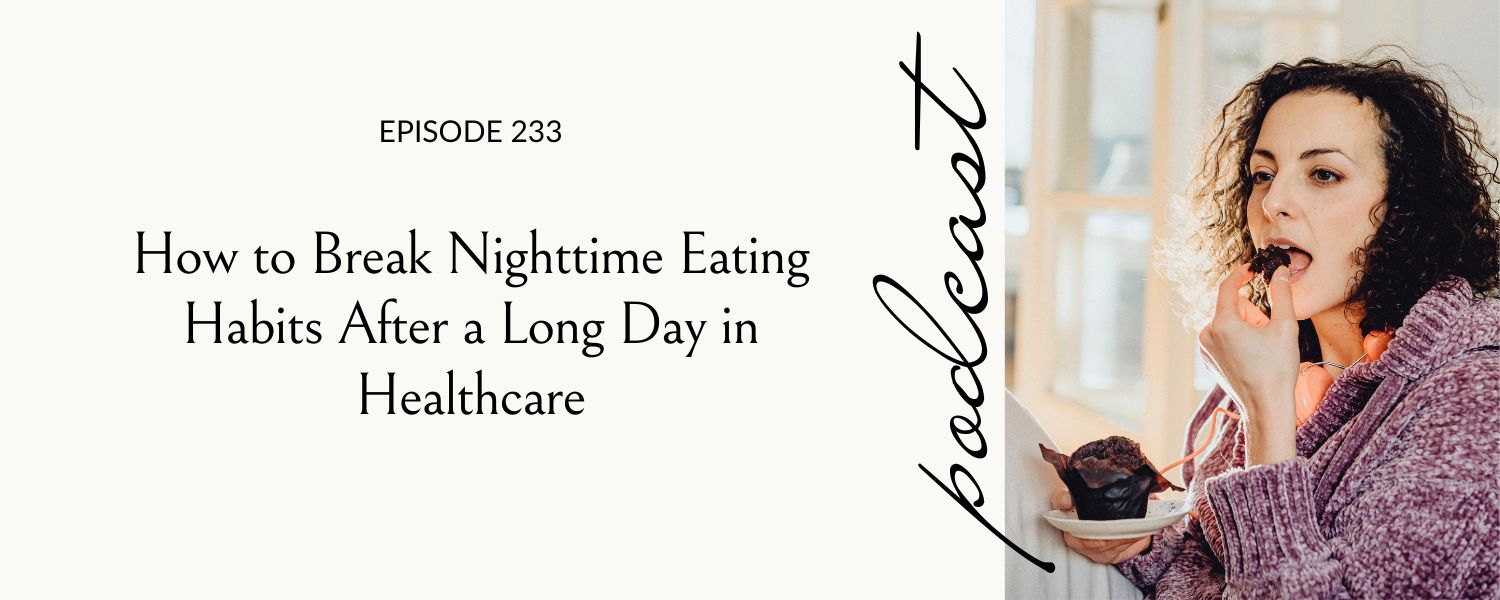
How to Break Nighttime Eating Habits After a Long Day in Healthcare
Nighttime eating after a long healthcare shift is rooted in stress physiology and unmet needs, not a lack of discipline, and this episode explains exactly why.
Former Physician Assistant turned Eating Habits & Weight Loss Coach, Kate Johnston, breaks down the real reasons the habit feels so automatic after a demanding day and shares a 90-second body reset you can use tonight to interrupt the cycle.
If you’re a woman in healthcare who’s tired of ending every shift in front of the fridge, this episode is your starting point.
🎧 Listen with the player below. Or, keep scrolling for the readable version.
Listen Now:
Finally break free from overeating and emotional eating habits: Book a Free Consult.
Follow the Show and listen to more episodes to start forming healthier eating habits.
Related Episodes:
- 🎙️How to Stop Your Nighttime Snacking Habit (After Taking Care of Patients All Day)
- 🎙️5 Signs You CAN Stop Overeating at Night (Even If It Feels Impossible)
Readable Version:
How to Break Nighttime Eating Habits After a Long Day in Healthcare
Breaking nighttime eating habits starts with understanding that the urge to eat after a stressful shift isn’t about the food and it isn’t about willpower. It’s about a depleted nervous system, unmet needs, and stress physiology that have been building all day long.
You spend your entire shift taking care of everyone else. You barely sit down. You push through the hunger, the exhaustion, the back-to-back decisions.
And then you walk in the door and suddenly can’t stop eating.
You’re standing in front of the fridge before you’ve even put your bag down. You’re grazing through the pantry even though you’re not truly hungry. You’re eating past full and wondering why you keep doing this.
You are not alone. And there is nothing wrong with you.
I’m Kate Johnston, an eating habits and weight loss coach for women in healthcare and a former Physician Assistant with 15 years of clinical experience. I lived this exact pattern during my years as a surgical PA, coming home after long OR days and back-to-back office patients feeling like food was the only thing that could bring me back to life.
I overcame it. And I help my clients do the same.
This post explains exactly why nighttime eating feels so automatic after a demanding shift, and gives you one simple tool you can use tonight to start interrupting the cycle.
Why Is Nighttime Eating So Hard to Stop After a Stressful Shift?
Most people assume nighttime eating is a discipline problem. It isn’t.
It’s a stress and physiology problem. And once you understand that, the shame starts to lift and the path forward gets a lot clearer.
Here’s what’s actually happening in your body and brain after a long shift:
- You’ve been in high-alert mode all day. Your nervous system has been running in survival mode for hours, making constant decisions, managing stress, absorbing the emotional weight of patient care.
- You may be underfueled. If you skipped or rushed lunch, your body has a real energy deficit by the time you get home. The moment food is near, relief kicks in almost immediately.
- Stress hormones are driving cravings. Cortisol specifically increases cravings for high-reward foods. Salty, sweet, fatty foods aren’t a character flaw. They’re what your stressed brain is chemically drawn toward.
- Nighttime is the first time you’ve felt off duty. All day you’ve been “on.” Home is where you finally exhale. And food becomes the symbol of that exhale.
- Your needs went unmet all day. No real lunch break, no bathroom break, barely a sip of water. All of that comes crashing in the moment you walk through the door.
This isn’t about you or your job or food. It’s about what happens to a human body after a day of that much output.
What Are the Most Common Reasons for Nighttime Overeating in Healthcare Workers?
These are the patterns I see most often in my clients:
- Undereating during the day and arriving home in a genuine energy deficit
- Stress hormones driving intense cravings for comfort foods
- Using food as the only available reward after a demanding shift
- Food becoming an automatic symbol of relief and decompression
- Emotional exhaustion that hasn’t been processed in any other way
- The habit becoming so ingrained it happens on autopilot before a conscious decision is even made
Any one of these is enough to drive the habit. Most of my clients are dealing with several at once.
Does Nighttime Eating Mean Something Is Wrong With You?
No. Absolutely not.
The habit makes complete sense given what your body and brain are going through every single day. Understanding that is actually the first step to changing it, because shame and self-blame keep the cycle going rather than breaking it.
I want you to hear this clearly: you are not someone who will never have control of your eating habits. You are someone whose nervous system has been doing exactly what it was designed to do under stress. That is a very different thing.
The 90-Second Body Reset: A Simple Tool to Interrupt Nighttime Eating Tonight
This is not about directly controlling what or how much you eat. It’s about giving your nervous system a pause so it stops automatically driving the urge to eat before you’ve even checked in with what you actually need.
Here’s how it works:
- When you get home, take 10 seconds to put your stuff down and sit. Drop the bag, put the phone somewhere else, and just sit. That’s it. 10 seconds.
- Spend about one minute breathing normally with your hand on your stomach or chest. No phone. Eyes closed if that feels comfortable. You don’t need slow deep dramatic breaths. Normal breathing while simply connecting with your body is enough. This helps regulate your nervous system and creates a felt sense of safety that your body has been missing all day.
- Spend about 20 seconds checking in with your body. Are you actually hungry? Are you thirsty? Are you tired? Are you sad, anxious, or overwhelmed? Just notice. No judgment, no fixing. Just a quick honest scan.
That’s 90 seconds total.
Then give yourself what you actually need. Maybe it is food. Maybe it’s a glass of water. Maybe it’s five minutes lying down with your eyes closed. The goal isn’t to stop eating. It’s to interrupt the autopilot and make a conscious choice rather than an automatic one.
Even a 10% reduction in the urgency to eat is a win. That small pause gives your nervous system a chance to downshift out of the survival mode it’s been in all day.
Why Willpower and More Rules Make Nighttime Eating Worse
This is important.
If you try to solve nighttime eating with more control, stricter rules, or more willpower, you will strengthen the cycle rather than break it.
Your brain resists rules the same way a tired child resists bedtime. The more you clamp down, the harder it pushes back.
More control actually produces less control. When you try to control less, you end up feeling more in control. That’s not a paradox. It’s just how the brain works.
What Does Long-Term Change Actually Look Like?
The 90-second reset is a starting point. A real quick win you can use tonight.
But lasting change comes from going deeper. Here’s what that involves:
- Eating adequately during the workday so you don’t arrive home in a deficit
- Building a transition ritual between work and home that helps your nervous system decompress
- Learning to be with emotions rather than eating over them
- Letting go of moral labels around food so a cookie is just a cookie and not evidence of failure
- Changing how you think about yourself, not just how you think about food
- Doing all of this consistently enough that new habits actually form
When these pieces come together, weight loss becomes a natural side effect rather than the thing you’re constantly white-knuckling toward.
Imagine coming home after an emotionally and physically exhausting shift and actually being able to decompress first.
Sitting down to dinner with your family and genuinely enjoying it.
Going to social events and eating normally without the spiral that follows. Losing weight without tracking, cutting, or fighting yourself every step of the way.
That’s not a fantasy. That’s what happens when your nervous system and your relationship with food actually change.
How Can Coaching Help Break Nighttime Eating Habits for Good?
Knowing what to do and consistently doing it in your real life are two completely different things.
In my 1:1 coaching program Lighter, we work through your specific patterns, your specific schedule, and your specific stress load. We figure out what’s actually driving the nighttime eating in your life and build a strategy around that. We address the thoughts that get in the way, troubleshoot what isn’t working, and keep going until the new habit genuinely feels like you.
Not a set of rules to white-knuckle. Not someone else’s plan dropped onto your life. A way of eating that actually fits.
Ready to Finally Feel Calm, Confident, and In Control Around Food?
Right now the emotional and physical discomfort this is causing you will keep compounding. The longer the habit continues the stronger it gets. That’s not meant to scare you. It’s just the truth, and you deserve to hear it.
You take care of everyone else all day. It’s time to support yourself too.
We’ll look at your specific patterns, your schedule, your stress load, and what’s actually driving the nighttime eating. I’ll show you how to break the cycle in a way that helps you feel energized, comfortable around all foods, and able to lose weight naturally without willpower or medication.
Let’s help you finally feel calm, confident, and in control. Book your free consult by clicking the button below.
Kate Johnston is an Eating Habits and Weight Loss Coach, host of the Eating Habits for Life podcast, and a former Physician Assistant with 15 years of clinical experience. She specializes in helping women in healthcare break overeating and emotional eating habits for good through mindset and strategy coaching in her 1:1 program, Lighter.

KATE JOHNSTON
Eating Habits & Weight Loss Coach
I help women in healthcare break their toughest eating habits like overeating and emotional eating, for a healthy relationship with food and sustainable weight loss.
How to Start: Book a free consult with me below.