
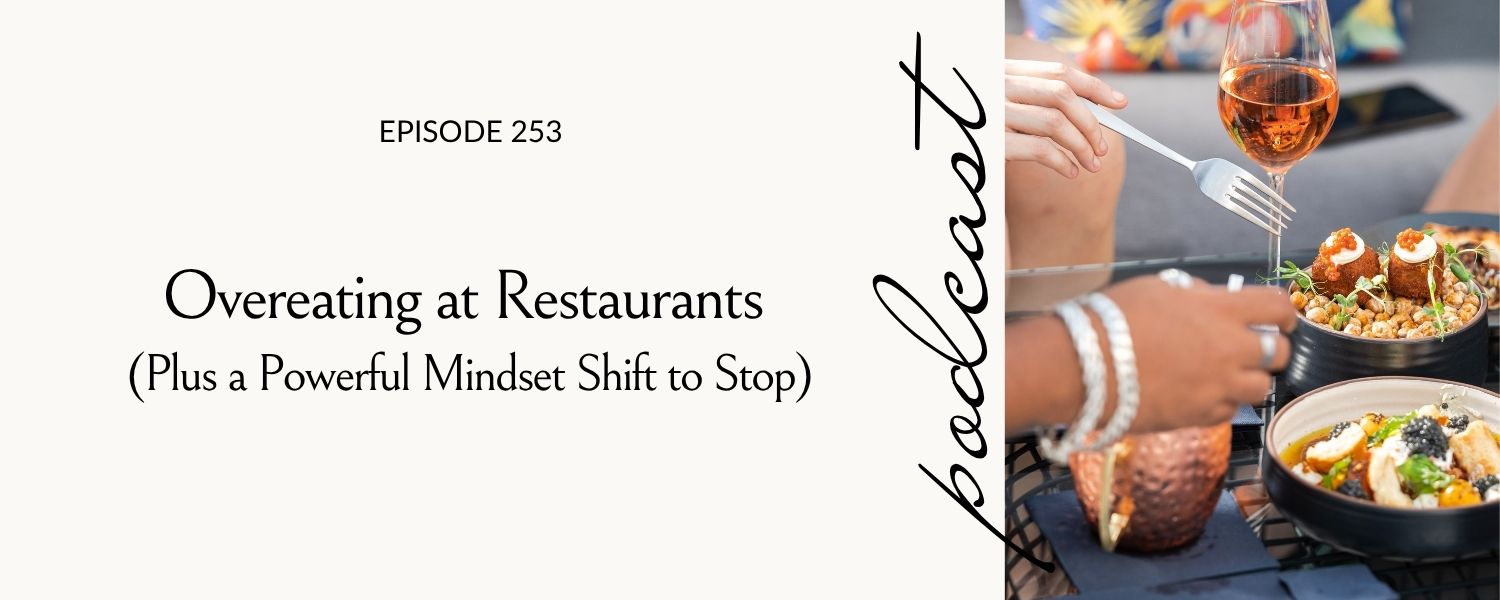
Overeating at Restaurants (Plus a Powerful Mindset Shift to Stop)
Kate Johnston, Eating Habits and Weight Loss Coach and former Physician Assistant with 15 years of clinical experience, explains why so many women end up overeating at restaurants even when they already know they’re full.
She unpacks the automatic thought behind overeating past full, and shares a client example of how reframing that thought led to lasting change. Listeners walk away with one simple question to ask mid meal to stop overeating when eating out.
🎧 Listen with the player below. Or, keep scrolling for the readable version.
Listen Now:
Take the next step to eating habits that finally support the life and body you crave. Start with a Free Consult.
Follow the Show for more insight, mindset shifts and action steps.
Related Episodes:
- 🎙️5 Signs You CAN Stop Overeating at Night (Even If It Feels Impossible)
- 🎙️How to Avoid Overeating in Social Situations
Readable Version:
Why Do I Overeat At Restaurants? The Real Reason (And How To Stop)
Most restaurant overeating has nothing to do with willpower. It comes down to one automatic thought about wasting food or money, and once you learn to catch that thought, stopping at full gets a lot easier.
If you’ve ever left a restaurant feeling way too full, even though you knew halfway through the meal you were already satisfied, you’re not alone. And it’s not a character flaw.
I’m Kate Johnston, a former Physician Assistant with 15 years of clinical experience, and now I’m an Eating Habits and Weight Loss Coach for high achieving women. I hear this exact scenario from clients all the time… they go out to eat, they’re already full, and they keep going anyway.
So let’s talk about why that happens, and what actually helps.
What causes overeating at restaurants?
A few things are usually happening at once. The food tastes good, so there’s a pull to keep eating just for the pleasure of it. There’s also a thought that shows up almost automatically, something like “I paid for this, I shouldn’t let it go to waste.” And if you’re eating with other people, the momentum of everyone else eating can pull you along too.
For most of my clients, it’s that second one that drives the overeating at restaurants the most. The thought about wasting food, or wasting the money they just spent.
Common signs this is happening to you:
- You grew up being told to finish everything on your plate
- You finish your plate even when you feel satisfied halfway through
- You feel guilty at the idea of leaving food behind
- You associate a fuller plate with getting your money’s worth
- You feel uncomfortably full walking out of the restaurant, most times you eat out
Why do I feel like I have to finish my plate?
Because your brain has fused two separate decisions into one. The money decision and the eating decision feel like the same choice, but they’re not.
Here’s the thing… the money was spent the second you ordered. Whether you eat that last bite or not, it’s not coming back. So the eating decision and the money decision are actually completely separate. Your brain just doesn’t experience it that way.
A lot of us also grew up hearing we needed to finish everything on our plate, so that belief gets layered on top of the money piece too. Both are real. Both can be reworked.
The mindset-action cycle behind restaurant overeating
This is a framework I use with every client in my program, Lighter, and it applies perfectly here.
A thought leads to a feeling, and that feeling drives an action. So when the thought is “I can’t waste this food,” the feeling that follows is often anxiety or guilt. And the action that follows that feeling is finishing the plate, even past the point of fullness.
Here’s the shift… what’s actually being wasted if you eat food you don’t need? The cost isn’t just the food on the plate. It’s feeling physically uncomfortable, feeling frustrated or disappointed in yourself afterward, and it works against whatever goal you’re trying to hit, whether that’s weight loss or just feeling better in your body.
Once you see it that way, the “waste” argument flips. Overeating at restaurants (or anywhere) is actually the more costly choice. Boxing it up, or simply leaving it, is not.
How to stop overeating when eating out
- Remind yourself the money was already spent the moment you ordered, so eating more doesn’t change that
- Order like you normally would, and eat until you notice you’re satisfied, not stuffed
- Somewhere in the middle of the meal, pause and check in with your hunger
- Ask yourself the one question below before you keep eating
- If you’re full and there’s food left, box it up rather than finishing it
That one question is this: “Am I still eating this for me, or for the money that’s already spent?”
It does 3 things at once. It gets you to actually check in with your hunger. It creates space for an intentional decision, rather than an automatic one. And it reminds you the money is already spent either way, so finishing the plate doesn’t undo that.
This client used this re-frame to stop overeating at restaurants
One of my clients used to leave every dinner out feeling overly full. She grew up being told to finish her plate, she genuinely enjoys eating out with her husband, and she often finds herself at networking events surrounded by other people eating. All the ingredients for overeating at restaurants, all at once.
We worked on reframing the waste, the same way I walked through above. Once that thought shifted, she was able to actually use the strategies we built together, rather than white knuckling her way through every meal out.
Now she pays attention to her hunger, stops when she’s satisfied, and gets 2 or 3 meals out of one entree by boxing up what’s left. When her husband doesn’t finish his either, she just lets it go. Because she genuinely believes now that eating it would be the more wasteful choice.
What my clients ask me most about this
The question I hear most is some version of, “How do I get past feeling like I’m wasting money if I don’t finish it?”
And my answer is always the same. The money was already spent the second you ordered. What you do with the food after that point doesn’t change what you paid. So the only real choice left is whether that extra food ends up in a to go box, or ends up making you uncomfortably full.
Quick answers to what you’re probably wondering
Is overeating at restaurants a willpower problem?
No. It’s driven by an automatic thought about wasting food or money, not a lack of self control. Changing the thought changes the behavior.
Why do I overeat more when eating out than at home?
Restaurant portions are often larger, the cost feels higher per meal, and there’s more social momentum around eating with others, all of which make the “don’t waste it” thought stronger.
What can I do instead of finishing my plate?
Check in with your hunger mid meal, ask yourself if you’re still eating for you or for the money spent, and box up what’s left if you’re satisfied.
Ready to stop overeating at restaurants?
This overeating at restaurants pattern is rarely just about restaurants. It’s usually one example of a thought that’s driving your eating in a lot of places, and once you learn to catch it here, it gets easier to catch everywhere else too.
In my coaching program, Lighter, this is exactly the kind of work we do together. We find the specific thoughts driving your eating, whether that’s at restaurants, at home, or under stress, and we build new ones that actually support the results you want.
If you’re ready to feel calm, confident, and in control around food, free from the frustration and shame that’s been following you around every time you eat out, book your free consultation. Let’s find out what’s actually driving your eating, and build something that finally works.
Kate Johnston is an Eating Habits and Weight Loss Coach, host of the Eating Habits for Life podcast, and a former Physician Assistant with 15 years of clinical experience. She specializes in helping high-achieving women break overeating and emotional eating habits for good through mindset and strategy coaching in her 1:1 program, Lighter.

KATE JOHNSTON
Eating Habits & Weight Loss Coach
I help high-achieving women change their eating habits at the root to support the life & body they love.
Book a free consult for your roadmap to a healthy relationship with food and weight loss you can keep.