
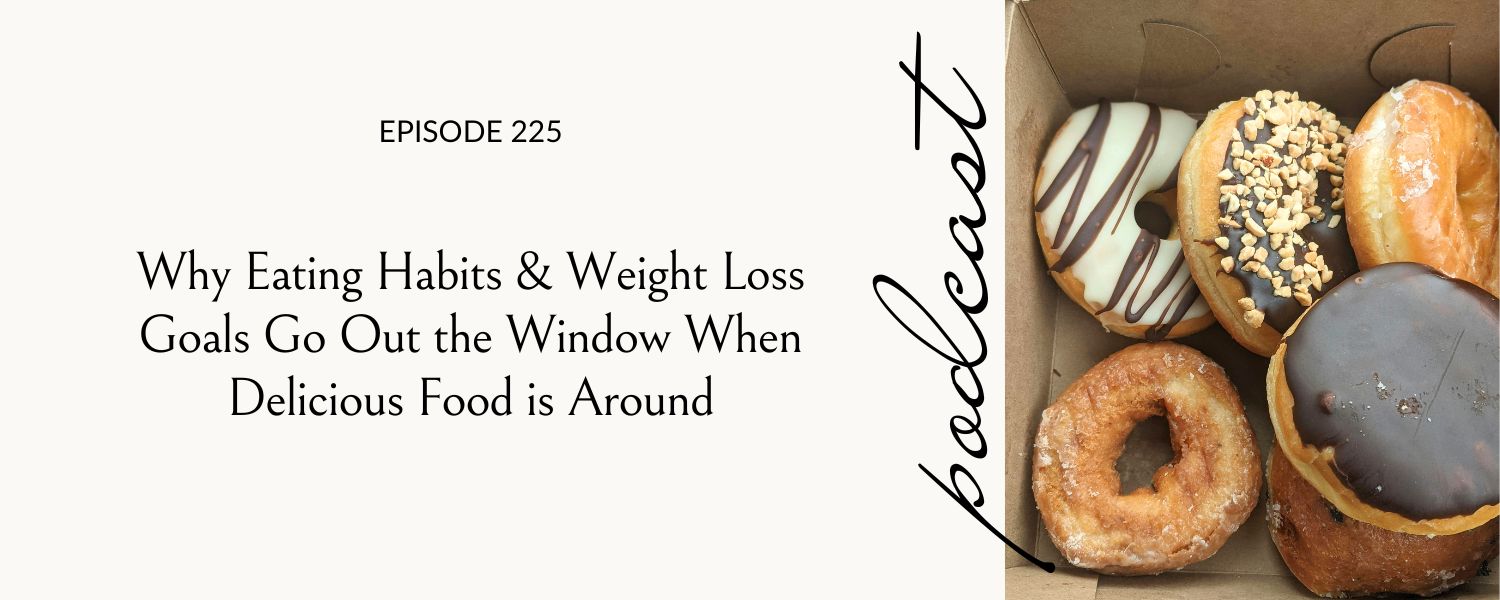
Why Eating Habits & Weight Loss Goals Go Out the Window When Delicious Food is Around
If you’ve ever walked past the break room after a hectic morning with patients and devoured the dessert a drug rep brought in before you even had a chance to think, this episode is for you.
You’ll learn exactly why your brain prioritizes that short-term pleasure over your eating habits and weight loss goals, especially when you’re stressed, overwhelmed, or mentally exhausted from a long shift.
Plus discover what you can actually do about it that doesn’t involve a willpower battle — because we both know how that goes at the end of a long day.
Walk away with a simple strategy to slow it down, check in, and start making intentional choices around food without fighting your cravings.
🎧 Listen with the player below. Or, keep scrolling for the readable version.
Listen Now:
(If player is taking a while to load, just refresh the page.)
Having the information and applying it are completely different. Get help applying it – Book a Free Consult.
Want more episodes like this? Follow the Show so you don’t miss new ones.
Related Episodes:
- 🎙️5 Ways to Avoid Stress Eating While Working in Healthcare
- 🎙️Why Burnout Makes Food Feel Out of Your Control
You’re ready to break free from unhealthy eating habits, lose weight and keep it off.
Your next step is to book a free consult with me.
Click the button to book now and start feeling in control with food and confident in your body.
Enjoying the Show?
Help others discover the podcast by leaving a quick rating or review! It makes a huge difference.
- Rate/review on Apple (iTunes) HERE
- Rate on Spotify HERE
Know someone who’d benefit?
📩 Send them this episode link!
📖Episode Transcript (Easy-to-Read Version):
Why Your Eating Habits and Weight Loss Goals Go Out the Window When Delicious Food Is Around
You walk by the break room after a hectic morning with patients, or clients, or back-to-back meetings, whatever your day looks like, and there it is.
The dessert a drug rep brought in. Or the birthday cake a colleague made. Or the box of donuts someone left on the counter.
And before you’ve even had a chance to think about your eating habits or weight loss goals, you’ve devoured it. Maybe in 3 bites. Maybe 4 if you’re lucky.
And then comes the thought: why did I do that?
Followed by the inward groan. And a side serving of shame.
I know. I’ve been there. My clients have been there. And if you’re reading this, you’ve probably been there too — more times than you’d like to count.
Here’s what I want you to know first: it makes complete sense that you’d feel pulled toward that food. It’s pleasure during a time of displeasure. And it’s something you absolutely can change….without turning it into a willpower battle that you’re destined to lose by 3pm.
Why This Actually Happens (It’s Not About Willpower)
Okay so here’s the thing. There’s a part of your brain — your primitive brain — that is entirely focused on one thing: keeping you alive.
This part of your brain cares deeply about three things:
- Short-term pleasure
- Avoidance of pain or discomfort
- Saving or increasing energy
Notice what’s not on that list? Your long-term health goals. Your weight loss goals. The fact that you’ve been trying to eat better lately. None of that registers for this part of the brain, especially in the moment.
Way back when we were surviving day to day, this made complete sense. Your brain needed to prioritize the next 10 minutes, not the next 10 years. And that wiring is still very much running in the background today.
So here’s what happens when you walk past the break room after a stressful morning:
Your primitive brain sees something pleasurable, the dessert, the donuts, whatever it is, while you’re already feeling some level of discomfort. Stress, overwhelm, exhaustion, frustration. And it immediately does the math:
Pleasurable food = short-term pleasure + increased energy + decreased discomfort.
It hits all three of its priorities at once. Especially with something sweet…. you’re getting a hit of sugar, which means a quick burst of energy, plus the pleasure of something that tastes good, plus a moment of relief from whatever stress you were carrying.
Your brain is not going to stop and think “but wait, I’ve been trying to lose weight.” It’s going to go straight for the thing that checks all three boxes. Every time.
This is not a character flaw or you lacking willpower. This is your brain doing exactly what it was designed to do.
So What Can You Actually Do About It?
Here’s where I want to be really clear: the answer is not more willpower. Especially not at the end of a long shift when you’re mentally and physically depleted. Willpower requires conscious mental effort — and that’s exactly the resource that’s most drained when you need it most.
Instead, here’s what actually works.
Meet Yourself Where You Are
Right now, the pattern probably looks something like this: you see the food, something happens very fast in your brain, and you’re eating it before you’ve made a conscious decision.
It feels almost automatic. Because it basically is, especially if this has been happening for a while and it’s become a habit.
So the first move isn’t to stop the behavior. It’s to slow it down.
Instead of trying to white-knuckle your way past the break room, you’re going to meet yourself where you actually are, which is mid-reach, or mid-bite, or standing in front of the counter…. and just pause.
The Pause and Check-In
Here’s what the pause looks like in practice. Before you eat it — or even during or after if you forget at first — you check in with yourself and ask:
Am I actually hungry for this right now?
And then: What am I actually feeling right now?
And the most helpful question: Do I really need this — or am I stressed, overwhelmed, something else?
That’s it. You’re not trying to force yourself to make a different choice yet. You’re just getting curious. Just inserting a little bit of awareness between the cue and the action.
This sounds simple. It kind of is. But done consistently, it does something really important — it creates a tiny bit of space where a conscious decision can happen. And that space is where everything starts to change.
What This Looks Like in Real Life
One of my clients (I’ll call her Amy) used to eat the desserts her colleagues brought in almost every single day at work. It felt automatic. She’d see them, she’d eat them, and she’d feel that familiar combo of momentary relief followed by frustration with herself.
We didn’t try to control the food. There was no plan to avoid the break room or use willpower to say no.
Instead, we worked on the pause and check-in. She got really good at stopping for just a moment, asking herself that question, “do I really need this right now, or is something else going on? ” and then actually answering it honestly.
We also figured out her specific triggers. So instead of a general check-in, she got really specific: is this one of those moments? And most of the time, the honest answer was no. She wasn’t hungry. She was stressed, or tired, or just in the habit of reaching for something sweet when things got hard.
The result? We weren’t even halfway through our coaching together and she’d gone from eating the break room sweets almost every day to being able to pass them up naturally, without fighting any cravings or urges with willpower.
And on the occasions when she really did want something? She’d have a bite, enjoy it, feel satisfied, and move on. No guilt spiral. No starting over Monday.
She saved so much mental energy by not fighting herself constantly. And that shift started with one simple pause.
The Key That Makes This Actually Work: Consistency
Here’s the part I don’t want you to skip over, because it’s where most people get tripped up.
Doing this once or twice helps in the moment. But what actually breaks the habit over time is doing it consistently, enough times that the pause itself becomes the new habit, and the automatic reach for the food starts to lose its grip.
I know consistency is the tough part. Especially when you’re busy, depleted, and working in a demanding environment where you’re giving a lot of yourself every single day.
But here’s what I want you to remember: you’re not trying to snap this habit in half overnight. You’re weakening it. Little by little, check-in by check-in. Like sawing through a rope rather than trying to pull it apart from both ends.
And the more you practice, even imperfectly, even when you still eat the cookie after checking in, the more the habit starts to loosen. Until one day you walk past the break room and realize you didn’t even think twice.
That’s not willpower. That’s a changed habit. And it feels completely different.
Why This Is Hard to Do Alone
Knowing that pausing and checking in is the move is one thing. Being able to do it consistently, in the middle of a hectic shift, when your brain is running on empty and the cookies are right there, is genuinely hard on your own.
The skill itself isn’t complicated. But building it into a real habit, figuring out your specific triggers, and doing it consistently enough for it to actually change something? That’s where having support makes all the difference.
This is exactly the work I do with women in healthcare inside my 1:1 coaching program, Lighter — and it’s the foundation of everything else we build from there.
You’ve been at this long enough. You’re ready to take the next step in taking charge of your eating habits so that you naturally become the person who chooses foods that truly make you feel good consistently.
To achieve that, you’re going to want clarity on what’s keeping you stuck, a deeper dive into why you want your goals (for stronger motivation), and a personalized stretegy to achieve those goals.
And that’s what I can offer you in a free consult.
So that’s your next step, especially since you’ve been struggling with this for a long time. Do something for your current self and future self, and book your free consult with me here.
You’ll get clarity and know exactly what needs to shift.
Ready to feel lighter?
A lighter body. Lighter relationship with food. Lighter emotional load. Lighter burden around eating.
A lighter way of living — for life.

KATE JOHNSTON
Eating Habits & Weight Loss Coach
I help high-achieving women change their eating habits at the root to support the life & body they love.
Book a free consult for your roadmap to a healthy relationship with food and weight loss you can keep.