
Hi, I’m Kate — I help women in healthcare lose weight sustainably, without willpower.
I’ll show you how in a free consult, which is a compassionate and safe space.
Hi, I’m Kate — I help women in healthcare lose weight sustainably, without willpower.
I’ll show you how in a free consult, which is a compassionate and safe space.
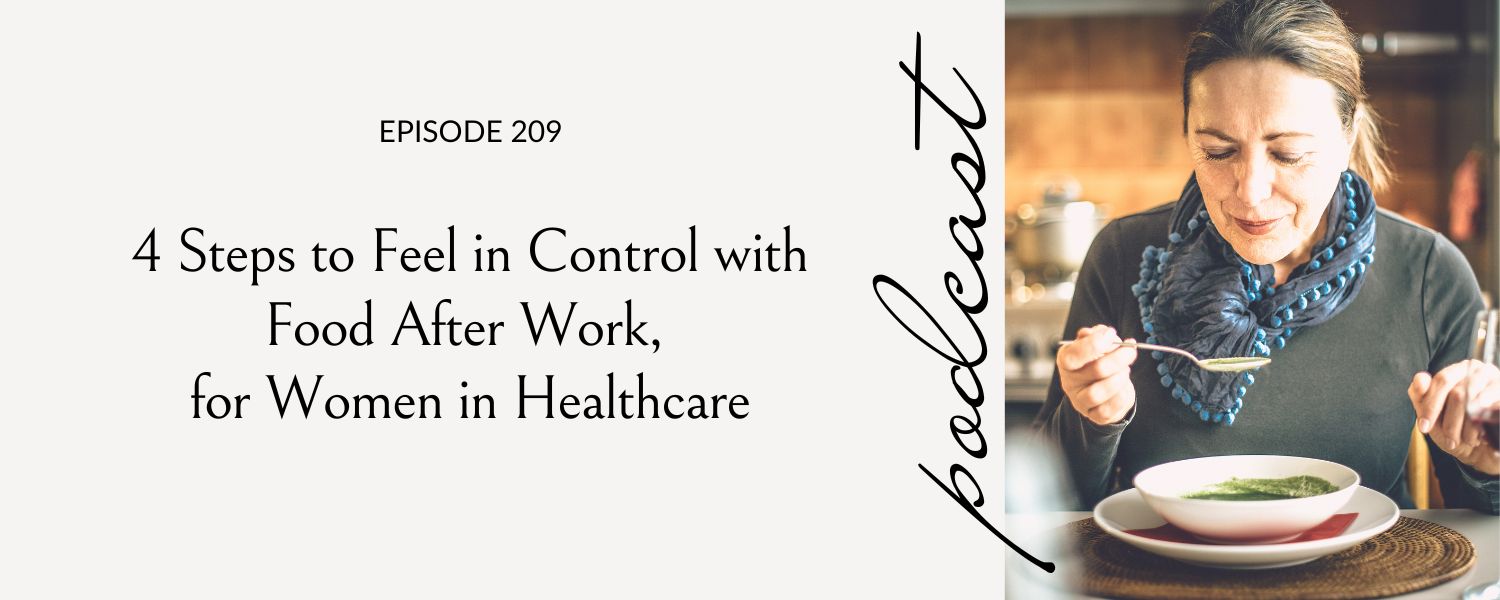
4 Steps to Feel in Control With Food After Work, for Women in Healthcare
Women in healthcare and similar roles are incredibly prone to losing control with food after work.
This shows up as:
- Stopping for takeout on the way home
- Binge eating snacks when you get home
- Overeating at dinner
- Mindless snacking at night
And the reason for this, will surprise you.
(Hint: It has something to do with your gifts rather than any flaws.)
So tune in to truly understand:
- Why these eating habits occur
- What’s making them worse
- What to do instead (that’s COMPLETELY opposite of what you’re doing now)
- 4 steps you can start doing today to feel more in control with food after work
Made with love for women in healthcare and similar care-giving or service-based roles. 🤍
🎧 Listen with the player below. 👇🏼Or, keep scrolling for the readable version.
P.S. 🤍If this episode feels like it was describing you…
I work 1:1 with women in healthcare through a coaching program designed to help you feel calm, confident, and in control around food — without deprivation or more willpower.
The first step is a free consult to explore what’s actually driving your eating habits and see if working together is a fit.
Listen Now:
(If player is taking a while to load, just refresh the page.)
Yes, You Can Lose Weight Without Willpower.
Imagine eating what feels good to your body, and trusting yourself around your favorite foods. Losing weight without forcing anything. Wanting to check yourself out in the mirror, and feeling confident.
You can have this, even if it feels far away right now. And even in a demanding career like healthcare.
Take the first step now with a free consult.
This is a safe and compassionate space for me to learn about you, and share my process that creates sustainable weight loss for you.
Click the button below to pick and date and time to meet.
Listen to This Next:
- 🎙️Women in Healthcare: What’s at the Root of Overeating and Emotional Eating
- 🎙️Why Burnout Makes Food Feel Out of Your Control
Enjoying the Show?
Help others discover the podcast by leaving a quick rating or review! It makes a huge difference.
- Rate/review on Apple (iTunes) HERE
- Rate on Spotify HERE
Know someone who’d benefit?
📩 Send them this episode link!
📖Episode Transcript (Easy-to-Read Version):
4 Steps to Feel in Control With Food After Work, for Women in Healthcare
Hey there, welcome to the Eating Habits for Life podcast. I’m Kate, your host, former stressed-out Physician Assistant who like you, would hold it together all day, and then be super impulsive with food when I got home and could finally relax.
So I know all too well, plus, I’ve had so many clients who are in healthcare and had very similar eating habits. You are not alone here, even though I know it can feel like that.
Today, I’m going to shed some light on why women in healthcare lose control with food after work. So either as soon as you are on your way home, come in the door, with dinner, or later at night.
My goal for this episode is for you to feel seen and understood, and by the end for you to:
- Understand why food feels urgent after work
- Stop seeing after-work snacking, bingeing, overeating at dinner, or mindless snacking at night as a personal failure
- Walk away with 4 simple steps you can start doing immediately that help you feel more balanced and fulfilled during the day, plus help break the habit of losing control of food later.
Your Typical Day in Healthcare…
Okay so tell me if this sounds like you…
You’re either directly involved in patient care, or you’re not, but you feel like you’ve just been revving your engines all day long, going from one person or task to the next.
You’re charting, making calls, answering emails, putting out fires, keeping on schedule with your patients…or not… but trying to manage the stress with that, and feeling like you’re doing an okay job.
Maybe you skip lunch, grab a little snack from the break room in between patients, meetings or tasks. Maybe you get a lunch break, but not really because you want to catch up on the morning before the afternoon starts, so you’re eating while working. Hey no judgment here, I was always super guilty of this.
You finally get out the door of the office or hospital, get in your car, and feel this relief. You start driving away and you feel a shift in your body. And then…the thoughts about food start creeping in.
“What am I gonna have for dinner? Do I even feel like that? What can I stop and get on the way home? Will this traffic clear up so I can get home and eat something?”
And maybe you’re hungry, but the emotions of the day have also hit, making that hunger feel more urgent.
But also, maybe you’re not truly hungry… and the emotions and fatigue of the day are flooding you. Sending your attention right to food.
Because when you’re barreling through your day ignoring your own needs, pushing down your emotions, “managing” your stress by just getting through the day trying not to let it affect your performance, food all of a sudden feels urgent.
Because it represents energy, comfort and relief, safety, survival, pleasure, a treat or reward for getting through the day.
And since it represents any or maybe all of those, you get a very powerful urge and a flooding of thoughts coming into your brain about food. And how you can get it quickly and in the most satisfying way.
All of a sudden, it feels very loud. And stays that way for the rest of the evening. Making you wonder what’s wrong with you, and feeling frustrated that it consumes so much of your free time, your thoughts, and your energy.
But don’t worry, because by the end of this episode, you’ll have a better understanding of why you seem to lose control with food after work, plus simple actions you can implement today to start making food feel less urgent and out of control, and more intentional. Making you feel a little more peaceful about it, starting today.
Why Women in Healthcare Are Prone to Losing Control With Food After Work
So, I know you. Because you’re in healthcare or a similar field where your ultimate goal is to take care of people, you do just that. You take care of other people as best as you can.
And because there are so many people to take care of, that usually means a pretty busy day, right? You’re not sitting around bored, twiddling (is that the word??) your thumbs.
So when other people and tasks come first, guess what your brain makes that mean? That you come last.
Which means:
You’re not actually tuned into your body’s needs like hunger, thirst, a breather, going to the bathroom, because you’re tuned into other people, meetings, emails you need to respond to.
You’re not actually tuned into your emotions, because the focus is on your actions, the things you need to do, the people who are waiting for you.
How this shows up:
Ignored hunger and thirst. You only get to those things when you have a moment. When everything or everyone is caught up.
Ignored “I need to go to the bathroom” signals. One of my clients was a PA in Urgent Care and she said often she would see patients, feeling a strong urge to have to pee and she felt like she couldn’t go to the bathroom before she went into the room because they had already been waiting awhile.
For me, when I was a PA, especially my surgery days, you’d have to ignore all those body sensations, because you were in surgery for hours sometimes.
It also shows up as ignored “I need a quick breather” signs. So, when you feel the tension in your body, but instead of taking a quick moment to relieve some of that tension or calm your nervous system, you add more to it.
It also shows up as reacting a bit more intensely than you wanted when a stressor arises, because you’re wound up very tight and are holding in all the stress and emotions.
It shows up as ignoring your need to cry, shake out a little anger, give yourself a little hug for the crummy day you’re having.
It even shows up as ignoring all the things you could be proud of that you did that day, celebrating the small wins, telling yourself you did an awesome job.
So guess what happens when we ignore our basic needs, hold in all the bad stuff, don’t make room for any good stuff? Our nervous system is quietly keeping tabs. It’s noticing.
It’s getting more and more concerned and feeling less and less safe. Because that’s what nervous systems do. You can think about it like this, your nervous system is getting nervous that it won’t survive.
And food? Food was always a sign of survival. When cave men spotted an opportunity for food? It meant themselves and their family were surviving one more day.
And even though you logically know that food is abundant…you and I still have an ancient brain. Our brains are similar to the brains that our ancestors had way way way back.
So you can imagine if this is your day, multiple days a week, this will add up, causing your body to notice more and more. And it’s going to try to find a solution in food. Because again, food signals safety. It signals comfort, relief, pleasure, a treat or reward, and energy. When these things are at an all time low, food feels like a magical solution, right? Makes a ton of sense.
Now, let’s tie this into what happens after work.
How This Shows Up When You Leave the Hospital or Office
You finally are getting in your car and you’re leaving A LOT of work stuff behind. Which means, your nervous system is like, “ahhhh, finally.”
But the thing is, it still wants and maybe even needs food. Now, it just gets the chance to seek it out, and fast.
So your brain starts thinking about food. Figuring out how to get it quickly and how it can maybe bring the most satisfaction.
You might stop for Chick fil-A on the way home. You might order Thai takeout. Or when you get home, you go straight to the kitchen and eat everything in sight. This is what one of my clients who was a nurse told me when we first started coaching together.
And the thing about it is that it feels urgent, you find yourself eating quickly. Or ordering without thinking. Eating and not even really getting to enjoy the food like you’d really like to.
Often my clients will even come to me and say they’ll go straight to the kitchen, eat something sweet or salty, then not be hungry for dinner, but then eat dinner with the family anyway. They feel ashamed after.
Or they’ll eat dinner, but then later mindlessly grab snacks to eat later when relaxing or watching TV, and then all of a sudden, the snacks just disappear and they don’t recall eating them.
Does any of this sound familiar to you too? I think so often we can feel like we’re the only ones who do these things, but that’s not the case. And just knowing that it’s not uncommon, and it’s women just like you doing it too, makes it feel a little bit better.
So what’s actually happening here is this:
Once you finally get that breathing room, that opportunity and food is available, you feel that pull toward it, because your brain is in that survival mode and takes over your actions.
Even if you have weight loss goals.
Even if you were “good” all day or “ate clean” all day.
It doesn’t matter. It feels like it needs the food to decompress, to feel better, to survive the emotions of the day.
But it doesn’t actually help things. Because food only provides short term things. Short term pleasure, comfort, even short term nourishment and energy.
And I know you logically know that, but that ancient part of the brain we have, the primitive part, doesn’t know that.
And here’s what happens next that makes food feel out of control after work:
Once you start doing any action that provides something like pleasure or relief, our brain is like, “ooooh, let’s remember that for next time.”
So the next time you have that busy, stressful day at the hospital or office, your brain recalls that food felt good later on, at least temporarily.
Done over and over again, it starts to become a new habit because habits are formed to save your brain energy. It takes energy to make a decision and do an action. So your brain makes a habit of this new action, takes the decision-making energy out of it, so then it just feels automatic.
Just like every time you get in your car. If you had to think deliberately about all the steps you had to do to start the car and get it to drive, that would take up more brain power. But once you start doing the same sequence of events over and over, your brain is like, “hmmmm, let’s save some energy and make a pathway of nerves that fire so that no thought is needed and the actions come quickly and automatically.”
So that just contributes to eating feeling out of your control sometimes. Food choices feeling out of your control sometimes. Because your brain is trying to save you energy by taking some decision-making out of it.
Does that make sense?
What You’re Trying That’s Making Your Eating Habits Worse
Alright, now let’s talk about what you’re trying to do to help the situation but is actually making it worse.
So, super quick story that I think will help you to understand. I recently was treated for insomnia by a therapist who specializes in insomnia. She does CBT-I and during our first session, she asked me all the things I’ve tried doing to treat my insomnia on my own. My list was long.
She told me something interesting.
That although I had excellent intentions and believed I was doing all the right things to try to treat it myself, like going to bed earlier (in attempt to get more sleep), staying in bed and trying to get myself to fall back to sleep even if I was lying awake for 2 hours already, trying all kinds of herbal supplements, I was actually inadvertently making my insomnia worse.
I was trying to control it too much.
And because of that, it persisted and got stronger.
This is what happens with eating habits.
I see it all the time…trying to eliminate sweets. Choosing the salad instead of the 3 slices of pizza. Trying to eat super clean and minimal after a day of bingeing on “junk.” Self-blame and shame in an attempt to punish yourself and make yourself do the right thing the next day by making you feel so badly about doing the “wrong thing.”
All of this having the opposite effect long-term than what you want. It makes your body and brain feel more unsafe. Over-restricting, too big of changes, negative self-talk. None of that is good for your brain or body. So it doesn’t work.
And then you get more frustrated and unhappy, more stressed about food, which adds to that emotional load you were already carrying, and adds to your nervous system feeling very unsafe, being dysregulated.
So it just adds fuel to the fire.
And honestly, is a lot of work for you too. You’re spending a lot of mental energy doing those things. I don’t know if you even realize that, but you are. There is an easier way though.
The Simple Solution to Feeling in Control with Food Later
Okay, so let’s chat about what actually helps.
That’s working with your body and brain. Being your own best friend and agent. Being the person who takes care of you. Takes care of your brain and body both.
So what exactly does that mean?
That means no smack-talking yourself. Those negative thoughts will come up, we can’t control the ones that pop up automatically. Our brains were created with a negativity bias, to try to look for danger. But now, we use that against ourselves, and tend to think a lot of negative thoughts about ourselves.
And that’s exactly one of the things I do with my clients. Help identify those negative thoughts, and show them that they aren’t the truth. They’re just sentences that are running through your head and we don’t have to believe them. When you don’t believe them, they can’t hurt you.
So we even work on disproving those thoughts, and quickly unraveling them to see that they aren’t true at all. Then they won’t affect your emotions or actions negatively.
The next thing is to give your brain and body rest when it needs it, stimulation or movement when it needs it, food when it needs it, water, love, support, joy, all the things that your body and brain need.
When you give it the things your brain needs and wants, it starts needing food less and less for these things.
For example, if food has been used to self-soothe after a tough day at work, nurturing yourself with some kind words, wrapping yourself in a soft blanket with a warm mug of tea, and maybe even doing something like writing in a journal or listening to relaxing music can be a new way to self-soothe. So then your brain and body have another option besides food.
Done often enough, it starts going more for that than for the food.
This is also a basis for a lot of the work I do when you and I work together. We do it in steps that build upon one another, so it feels very doable, and fits into your life.
It doesn’t feel like climbing a massive mountain…it feels like climbing one step at a time, celebrating, and having a guide with you every step of the way.
That’s so key to do it in small steps, because our brains do not like big changes. They don’t like anything drastic or too challenging. They like simple and doable. With plenty of rewards.
4 Steps to Start Feeling in Control with Food After Work
So how can you start working with your brain and body today?
Follow these 4 steps:
- When you notice a negative thought pop up that doesn’t make you feel good, just observe it as if it were a car going by on a highway. It’ll pass.
- Give yourself a little love with a thought that makes you feel good. Maybe it’s just a compliment for something you did that day. Or a compliment for the type of person you were being when you helped your colleague out or listened to your friend when she told you about a fight her and her husband had. Kind words to yourself make you feel good and when you feel good, you’re less likely to turn to food to feel good.
- Schedule in a tiny break at work to give yourself something you need. Or maybe a not so tiny break…maybe you can take a full lunch break, or take a few 10 minute breaks.
- If you feel an urge to eat later on and it feels out of your control, ask yourself what is it that you need. Is it really food or is it something else. And if you forget to do it before you eat, then do it after. That’s super helpful too.
✨ This is exactly the work I do with women in healthcare and similar fields through coaching— not to control food, but to help food stop feeling like the only relief.
Then habits of emotional eating, overeating, snacking impulsively, bingeing, mindless eating end up breaking which then means you feel in control of food without trying to deprive, restrict, portion control, etc.
Without using willpower or all this mental energy you’d rather be spending elsewhere.
An Invitation to Work Together to Completely Overcome This
So if what we’re talking about is hitting home for you, and you’re just really tired of your eating habits and weight taking up so much brain space…
You don’t need more willpower, self-help how-to’s, or another Monday start. You need a process that works with your life, your brain, and your patterns—and that’s what we build together in my 1:1 coaching program, Eat with Intention.
Where I help you be the boss of your eating habits again, so you feel calm, confident and in-control around food, and comfortable in your own skin again.
I invite you to book a free consult today, because every day you wait? You’re reinforcing the patterns that are keeping you stuck. But the moment you start getting support, your brain starts learning something new. That shift starts now with a free consult.
The consult is just a conversation for you to see what this path looks like for you specifically, and see what’s truly possible that you didn’t even realize.
So if you’re ready to stop feeling like food has control over you, and finally feel calm and confident with food and your body—tap the link in the show notes to take the first step and book your free consult right now as you’re thinking of it.
This is the fastest way to start feeling better, and enjoying more of your life. Book your free consult here to start.
A Noteworthy Final Thought
There are always reasons behind your eating habits that make complete sense, especially given your role in healthcare, your responsibilities, even the high standards you set for yourself, plus your very normal human brain.
There’s not something wrong with your brain or body, and the great news with that is you can have the relationship with food you want to have, which will in turn allow you to have more energy to do the activies you love, feel comfortable in your own skin, and feel confident and in-control around food.
If this episode helped, follow the show so you don’t have to remember to come back — I’ve got more coming that will meet you right where you are.
Thanks for listening and take care. And I invite you to book your free consult to start your journey today.
You CAN lose weight and keep it off.
By breaking habits like overeating and emotional eating, and thinking like the person who keeps it off naturally.
The first step is a free consult to discover how.

KATE JOHNSTON
Eating Habits & Weight Loss Coach
I help women in healthcare and perfectionists break their toughest eating habits like overeating and emotional eating, and lose weight sustainably.
Discover how by booking your free consult below.