
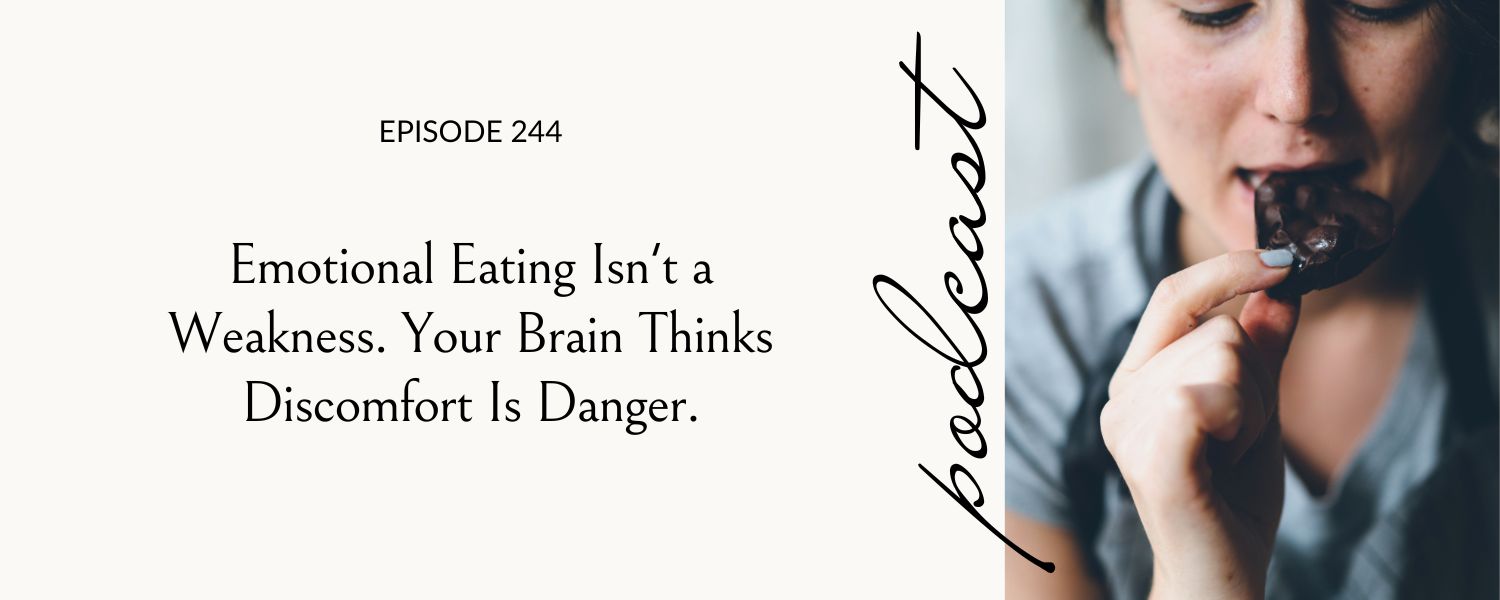
Emotional Eating Isn’t a Weakness. Your Brain Thinks Discomfort Is Danger.
In this episode of Eating Habits for Life, Kate Johnston explains why emotional eating is a survival response wired into the brain, not a character flaw or a failure of willpower.
Using an analogy about her dog’s reaction to fireworks, she breaks down why the brain treats emotional discomfort like physical danger and reaches for food as the fastest available relief.
She also shares her own experience with emotional eating as a Physician Assistant and why understanding the root cause is the first real step toward breaking the habit.
🎧 Listen with the player below. Or, keep scrolling for the readable version.
Listen Now:
Finally break free from overeating and emotional eating habits: Start with a Free Consult.
Follow the Show and listen to more episodes to start forming healthier eating habits.
Related Episodes:
- 🎙️Your Emotional Eating Habit Isn’t About the Food
- 🎙️Women in Healthcare: What’s at the Root of Overeating and Emotional Eating
Readable Version:
Why Do I Emotionally Eat? Your Brain Isn’t Broken, It’s Protecting You
Emotional eating happens because your brain treats emotional discomfort the same way it treats physical danger, and food is the fastest relief it knows how to offer. It’s not a character flaw or a lack of willpower, it’s your primitive brain doing its job, and that means this habit can actually be unlearned.
Here’s the thing. As a former Physician Assistant with 15 years of clinical experience, I’ve seen this pattern from both sides, in patients and in myself.
I know how easy it is to sit with a bag of crackers on the couch after a long shift and think something is deeply wrong with you. It isn’t.
Why do I emotionally eat instead of just dealing with my feelings?
You emotionally eat because your brain is trying to keep you safe, not because you’re weak. A part of your brain called the primitive brain has one job, which is to keep you alive, and it doesn’t know the difference between physical danger and emotional discomfort.
Way back in the day, staying alive meant avoiding pain, moving toward anything pleasurable, and conserving energy since food was scarce. Your brain still runs that same program today, even though you’re not actually in danger when you feel stressed, overwhelmed, sad, or even bored.
So when an uncomfortable emotion shows up, your primitive brain treats it like a threat and looks for the fastest way out. Food fits perfectly, since it’s pleasurable, it’s readily available, and it’s kept you alive your whole life.
WWhy does my brain choose food specifically?
Your brain reaches for food because it’s already proven, in your own history, that food brings fast relief. That relief doesn’t have to be lasting to count, it just has to work in the moment.
This is true even with foods that aren’t exactly “junk.” You can emotionally eat grapes and hummus just as easily as crackers and cookies, since it’s not about the food itself, it’s about the relief your brain associates with eating.
Once your brain sees that food calmed you down once, it will keep suggesting food the next time discomfort shows up. Do that enough times, especially around specific emotions or situations, and a habit forms that starts to feel automatic and out of your control.
Signs you might be eating for emotional relief rather than hunger
- You’ve tried to white-knuckle your way out of it with willpower, and it hasn’t stuck
- You eat at a specific time or in a specific situation, like every night after work, rather than because your body signals hunger
- The food you reach for is usually easy, pleasurable, and doesn’t require much effort
- You feel a wave of relief right after eating, followed later by shame, frustration, or defeat
- You’re eating even when you’re not physically hungry, or you keep eating past the point of feeling satisfied
How the thought-feeling-action loop explains emotional eating
Eating isn’t just a behavior you can white-knuckle your way out of, it’s the last step in a loop that starts upstream. A thought leads to an emotion in your body, and that emotion is what drives the action, in this case reaching for food.
So if you’re stressed about tomorrow’s schedule, that thought creates a feeling of overwhelm in your body. Rather than sitting with that feeling, your brain looks for the fastest way to make it go away, and food becomes the action that follows.
This is exactly why trying to control the eating directly so often fails. You’re working on the last link in the chain, rather than the thought and feeling that’s actually driving it.
Can an emotional eating habit actually be broken?
Yes, and this is the question I get asked more than any other. If habits like smoking or drinking can be broken, and you likely know someone who’s done it, an emotional eating habit is breakable too.
When I was still working as a PA, I ate cereal, Cheez-Its, and pretzels on the couch most nights after rough shifts. I thought I simply had no self control around those foods, but that wasn’t it, my brain was seeking relief from the day, and I was too exhausted to cook or prep anything else.
Once I understood what was actually happening, I stopped treating myself like the problem. And from that place, I found real solutions and stayed consistent with them until the habit was gone, even while still working the same demanding job with the same stressors.
Quick answers to what you’re probably wondering
Is emotional eating a sign of weakness?
No. It’s your brain confusing emotional discomfort with physical danger and looking for the fastest relief available.
Can healthy foods be part of emotional eating too?
Yes. Emotional eating is about the relief your brain associates with eating, not about whether the food is “good” or “bad.”
How long does it take to break an emotional eating habit?
It varies by person, but it starts with understanding the pattern and interrupting the loop upstream, at the thought and feeling, rather than only at the food.
Understanding it and actually changing it are two different things
Knowing why this happens gives you real relief, since it means you’re not weak, you’re not broken, and you’re not the only one dealing with this. But understanding the pattern and actually changing it are two different things, and the second part is usually where support makes the difference.
That’s not because you’re incapable. It’s because you’re too close to your own patterns to see them clearly, and rather than guessing at what might work, having someone walk you through it step by step changes everything.
Inside a free consult, I take an actual look at your specific patterns, rather than handing you generic advice. You’ll see exactly how I’d work with you inside Lighter, my 1:1 coaching program, and get your questions answered.
Before your next 12 patients, or everyone else’s needs take over your day again, go ahead and grab a time on my calendar.
You deserve to feel calm, confident, and in control around food, finally free from the food noise, frustration, and shame, and a free consult is where that starts.
Kate Johnston is an Eating Habits and Weight Loss Coach, host of the Eating Habits for Life podcast, and a former Physician Assistant with 15 years of clinical experience. She specializes in helping women in healthcare break overeating and emotional eating habits for good through mindset and strategy coaching in her 1:1 program, Lighter.

KATE JOHNSTON
Eating Habits & Weight Loss Coach
I help women who are successful everywhere else, break eating habits like overeating and emotional eating, and build habits that support the life and body they love.
Book a free consult for clarity, support, and a personalized strategy that fits your life.