
Stop The Snacking Spiral
3 steps to start today to feel in control quickly. Video class + bonus tool to stay on track.
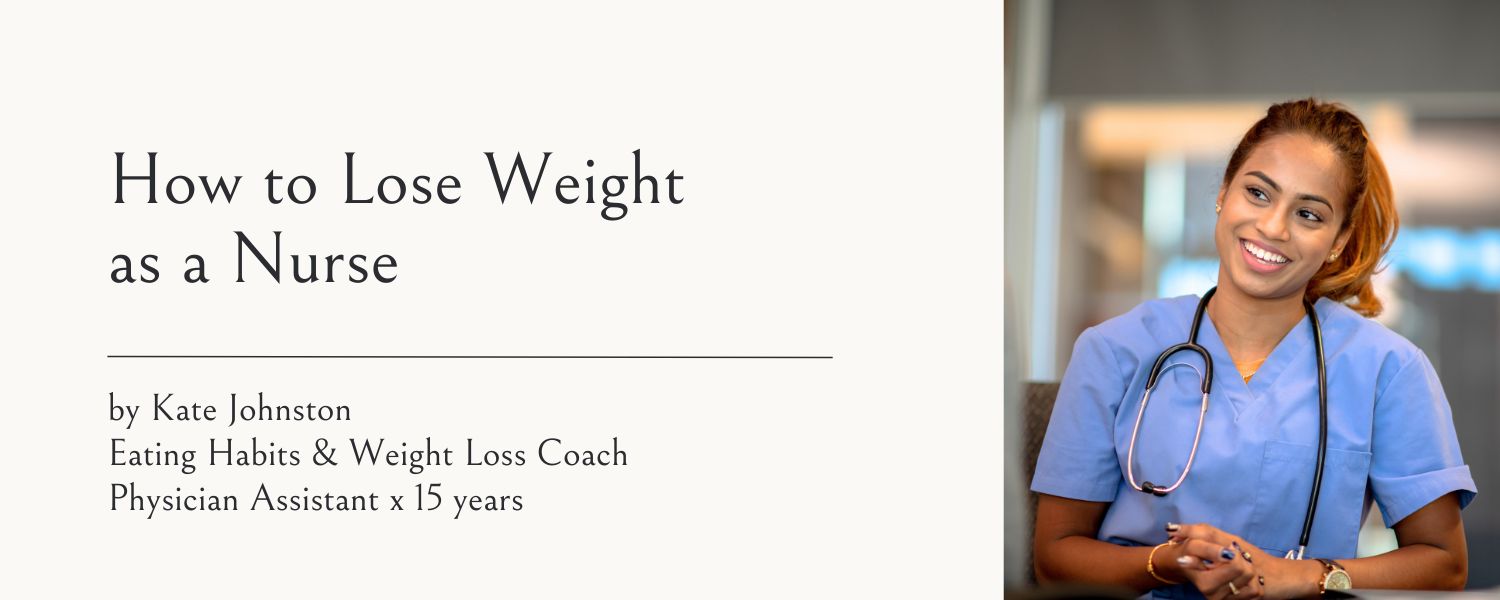
How to Lose Weight as a Nurse
If you’ve Googled “how to lose weight as a nurse,” you’ve probably found the same advice recycled everywhere: meal prep on your days off, pack your lunch, avoid the break room donuts, drink more water.
And you already know all of that.
You’re a healthcare professional. You understand nutrition. You know what you should be doing. The problem has never been information — it’s been everything that happens between knowing and actually doing it, consistently.
And after a 12-hour shift when your nervous system is depleted and the vending machine is right there, whispering to you.
I intend to close that gap for you. Because I’ve been there when I was a Physician Assistant.
I never needed the tips to eat healthier. I needed someone to explain why I was struggling with food and gaining weight, despite having the knowledge. And the approach to weight loss that actually would work for me.
Why Weight Loss Advice Usually Fails Nurses and Healthcare Workers
Most weight loss advice was written for people with predictable schedules, normal stress levels, and reliable access to food and sleep. That’s not your life.
(And honestly, even for those people, the weight loss advice still has major gaps.)
Your day involves emotional labor that most people can’t comprehend — absorbing fear, grief, frustration, and urgency for hours at a time while making clinical decisions that affect real lives.
By the time your shift ends, you’ve spent your mental and emotional reserves in ways that have nothing to do with food, and yet food is where the body goes to seek relief.
This isn’t a discipline problem. It’s a nervous system response.
The research backs this up. Nurses and healthcare workers have significantly higher rates of stress eating, emotional eating, and weight gain than the general population, and it’s directly tied to the demands of the work environment, not personal character.
So the first thing to understand about losing weight as a nurse is this: the standard approach won’t work, because it was never designed for your situation. Or your nervous system.
The Real Reason You Can’t Stay Consistent (It’s Not What You Think)
One of the most common things I hear from the nurses and healthcare workers I coach is some version of: “I know what to do. I just can’t stay consistent.”
And almost immediately after saying it, they add: “That’s why I don’t know if I can do it.”
Here’s what I want you to understand about that statement: consistency isn’t a personality trait you either have or don’t have.
It’s not evidence of your character or your commitment. It’s a skill… and like any skill, it’s influenced by the tools you’re using.
If you’ve been trying to lose weight through restriction, rigid rules, and willpower, you’ve been using the wrong tools for your specific life. They might work just fine temporarily when energy and motivation is high, but that’s not sustainable.
Your energy and motivation gets tanked taking care of other people all day. What’s left at 7pm when you’re standing in front of the fridge isn’t enough to white-knuckle your way through a craving.
- LISTEN OR READ: Struggling with Consistency? Here’s the Real Problem
- LISTEN OR READ: Creating Consistency for Sustainable Weight Loss
What Actually Works: A Habits-Based Approach to Weight Loss for Healthcare Workers
Instead of trying to overhaul everything at once (which requires enormous energy you don’t have) a habits-based approach targets the specific patterns driving your eating behaviors and weakens them strategically, one small piece at a time.
Here’s what that looks like in practice:
1. Understand What’s Actually Driving Your Eating
Most eating that feels out of control isn’t about hunger. For healthcare workers specifically, the most common drivers are:
- Stress and nervous system dysregulation — your body seeking relief from a day of sustained high-alert functioning
- Emotional eating — using food to process or suppress emotions that didn’t get processed during the shift
- Decision fatigue — after making dozens of clinical decisions, your brain defaults to automatic behaviors, including eating habits
- Reward eating — associating food with deserving a break, comfort, or something just for you after giving so much to others
- Schedule/food availability — maybe it’s long shifts, short breaks, or food is in the nurses’ lounge, or you didn’t pack enough
None of these are character flaws. They’re predictable responses to an extraordinarily demanding job. But they do need to be identified before they can be changed, because each one requires a different approach.
2. Work With Your Thoughts, Not Against Your Cravings
Here’s something most weight loss advice skips entirely: the thought that comes before the eating behavior matters as much as the behavior itself.
Your thoughts drive your emotions, which drive your actions. This is true in every area of life… and it’s especially true around food.
If you’re carrying the thought “I have no self-control around food” or “I always overeat when I’m stressed,” your brain is going to work hard to prove those things true.
Not because you’re weak, but because that’s how the brain works. It collects evidence for the stories it already believes.
One of the first shifts in sustainable weight loss isn’t a food change at all. It’s beginning to question those thoughts, and shifting them to ones that feel true but lead somewhere different.
For example, instead of: “I always stress eat after a hard shift.”
Try: “I’m learning to notice what I actually need when I get home.”
That’s not toxic positivity. That’s interrupting a thought pattern that’s been running on autopilot, which is the first step to changing the behavior that follows it.
Check out these 2 podcast episodes from my show, Eating Habits for Life, that are about thoughts and weight loss:
- LISTEN OR READ: 3 Mindset Shifts That Help My Healthcare Clients Lose Weight Without Willpower
- LISTEN OR READ: The Hidden Reason Weight Loss Isn’t Sticking (The Identity Shift Women in Healthcare Need to Hear)
3. Interrupt the Habit Loop Before Trying to Break It
Eating habits like stress eating, nighttime snacking, break room eating, aren’t random.
They follow a pattern: a cue triggers the behavior, the behavior produces a reward, and over time the whole sequence becomes automatic the more it’s repeated in the same context.
Trying to break that loop through willpower alone is like trying to snap a thick rope in half with your bare hands. It feels impossible because it basically is.
A more effective approach is to weaken the habit loop gradually… inserting a small pause, disrupting one link in the chain at a time, until the automatic nature of the behavior starts to loosen.
For nighttime snacking after a shift, for example, the first step isn’t “don’t snack.” It’s simply: pause before you go to the kitchen and ask yourself what you actually need right now.
That pause alone, done consistently, begins to interrupt the automatic sequence.
Over time it creates space for a different choice, without requiring the willpower you don’t have at the end of a long shift.
Breaking these habits is a crucial part in how to lose weight as a nurse, otherwise you’ll start falling back on old habits and gain the weight back.
4. Address the Stress Before It Reaches Food
One of the most overlooked weight loss strategies for healthcare workers is nervous system regulation — not as a wellness buzzword, but as a practical tool for reducing stress eating before it starts.
When your nervous system stays in a high-stress state throughout the day and never fully downregulates, food becomes one of the fastest ways your body knows to find relief. Not because you’re undisciplined, but because it works, at least in the short term.
Simple practices during the shift, a hand on your chest, noticing your breath for thirty seconds between patients, a brief walk outside, help regulate your nervous system incrementally throughout the day.
Over time this reduces the intensity of stress-driven food cravings in the evening, without requiring a major lifestyle overhaul.
I used to take a walk outside during my lunch break in my last job as a Physician Assistant before I left to coach full-time. I entered the afternoon feeling more grounded and calm.
5. Create Doable, Weight Loss Habits
When you start start strategically creating true habits of things that support weight loss, it sticks this time. It feels like it’s just part of your day, part of who you are to do these things.
And I’ve found that it even feels weird to NOT do these things once they’re truly habits. For example, I used to sometimes have 3 bowls of cereal for dinner when I was a stressed out surgical Physician Assistant.
It’s been so long since I’ve had well-balanced dinners that are super easy to cook at home, that it would feel so uncomfortable and weird to not.
Same thing with running. I don’t run as a weight loss tool. I run because of how it makes me feel. I run almost every day, so if I don’t run for a few days due to an injury or just needing a lot of recovery, it feels very weird.
Why This Is Hard to Do Alone
Everything above is straightforward in concept. The challenge is applying it consistently when you’re exhausted, depleted, and running on the reserves that are left after a demanding shift.
The gap between knowing these things and being able to use them automatically… in the moment, under stress, when it matters… is where most women in healthcare get stuck.
That’s because like I mentioned earlier, it’s not a knowledge problem. It’s a consistency and implementation problem that’s genuinely difficult to solve without support.
This is exactly why many nurses and healthcare workers who’ve tried everything finally see lasting results when they work with a coach who understands their specific situation.
Not because coaching gives them a meal plan or nutrition advice, but because it gives them the structure, accountability, and personalized approach to actually implement what they already know, consistently enough for it to change something.
Takeaway on Weight Loss for Nurses
Losing weight as a nurse isn’t about finding the right meal plan or finally having enough discipline. It’s about understanding what’s actually driving your eating patterns and addressing those root causes in a way that works with your life, not against it.
You spend your days caring for other people at an extraordinary level. You deserve an approach to your own health that takes your actual life into account.
Start with my free 5-day private podcast series Weight Loss Without Willpower. It’s 5 short episodes made specifically for women in healthcare, with discovery worksheets for each one. It will help you start to see what’s actually driving your eating patterns in a whole new way.
Click below to get free access to the private podcast + discovery worksheets.
Or if you’re ready to explore what help for this would look like, I’d love to offer you a free consultation for you to gain insight into what’s behind your eating habits and weight struggles.
Plus, what help would look like for you to finally change your relationship with food, habits, and lose weight for life.
Click below to book your free consult.
Ready to feel lighter?
A lighter body. Lighter relationship with food. Lighter emotional load. Lighter burden around eating.
A lighter way of living — for life.

KATE JOHNSTON
Eating Habits & Weight Loss Coach
I help high-achieving women change their eating habits at the root to support the life & body they love.
Book a free consult for your roadmap to a healthy relationship with food and weight loss you can keep.