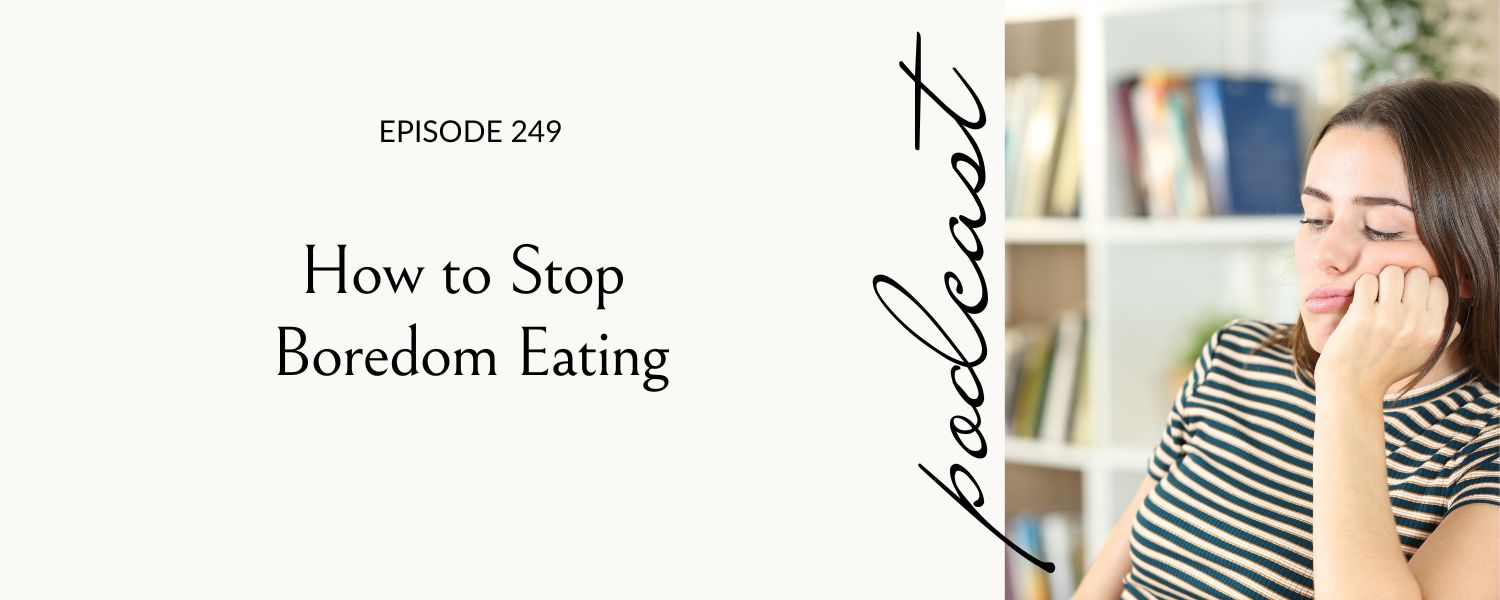
How to Stop Boredom Eating
In this episode, Kate Johnston explains the real cause behind boredom eating and why common fixes like scrolling your phone or swapping in “healthier” snacks don’t actually solve it.
She breaks down why boredom eating is especially common among busy, high-achieving women in healthcare and similar demanding careers, and how the pattern can be fully unlearned.
Kate also walks through how to effectively break a boredom eating habit, the same approach she uses with clients.
🎧 Listen with the player below. Or, keep scrolling for the readable version.
Listen Now:
Take the next step to eating habits that finally support the life and body you crave. Start with a Free Consult.
Follow the Show and listen to more episodes to start forming healthier eating habits.
Related Episodes:
- 🎙️When You Know You’re Not Hungry, But Eat Anyway
- 🎙️Emotional Eating Isn’t a Weakness. Your Brain Thinks Discomfort Is Danger.
Readable Version:
How to Stop Boredom Eating (Even If You’ve Tried Everything)
Boredom eating isn’t about willpower or having the wrong snacks in your house. It’s about boredom feeling too uncomfortable right now, and your brain reaching for food because food is the fastest way it knows to make that discomfort go away.
I’m a former Physician Assistant with 15 years of clinical experience, and now I coach women in healthcare through exactly this kind of eating pattern. Boredom eating comes up with almost every client I work with, so if this is you, you’re in very good company.
Here’s the thing though. You’ve probably been thinking the problem is boredom itself. Or that something’s wrong with your brain. Or that there are just too many tasty foods around and that’s the real issue.
None of those are the actual problem. And once you see what is, the solution looks completely different too.
What causes boredom eating?
Boredom eating happens because boredom feels uncomfortable, and your brain responds to discomfort the same way it responds to danger.
That sounds dramatic, but it’s how your brain is wired. Way back in the day, discomfort usually meant something threatening was happening. So your brain built in a system to protect you from discomfort fast, even discomfort as mild as being bored.
This shows up constantly with busy, high achieving women… nurses, physicians, PAs, NPs, lawyers, teachers, women in corporate roles. When your days are go go go, boredom feels foreign. And your brain, doing its job, tries to rescue you from that unfamiliar feeling.
The first time you ate in response to boredom, it worked. Eating gave you quick comfort, and it was easy and available. So your brain filed that away as a solution.
The next time boredom showed up, your brain suggested the same fix. And the time after that. Each repetition reinforced the pattern a little more, especially in the same settings… the couch in the evening, a slow stretch during your workday.
Why removing boredom doesn’t fix it
If you think the problem is boredom itself, it makes sense that you’d try to get rid of boredom. Maybe you pack your schedule even fuller. Maybe you scroll your phone to fill the space. Maybe you try eating “healthier” snacks instead, or you try not eating at all.
None of these hold up long term.
- Filling your schedule just delays the boredom, it doesn’t resolve how you respond to it
- Scrolling your phone creates a new habit, and you might end up doing both at once
- Swapping in healthier food still adds calories you didn’t need if you weren’t actually hungry
- Avoiding your trigger snacks doesn’t teach your brain anything new about tolerating boredom
Rather than trying to eliminate boredom, the real solution is to help boredom feel more comfortable, and to give your brain another option besides food.
How do you stop boredom eating? A step by step approach
#1 – Let the new pattern build over time. You won’t choose the new option every single time at first, and that’s fine. Even choosing it once out of five times starts to create momentum.
#2 – Change your relationship with boredom. Instead of seeing it as something negative you need to escape, start seeing it as a moment of peace, calm, or rest. This shift alone takes some of the discomfort out of it.
#3 – Get used to feeling boredom gradually. Don’t try to sit with it for an hour on day one. Start small and build from there, so your brain and body get used to the discomfort little by little rather than all at once.
#4 – Choose another option, one that fits you. Not a random distraction… something that actually feels good to you and aligns with the life you want.
#5 – Make that other option just as easy as food. If food is sitting right there and your alternative takes effort to set up, your brain will pick food every time. Easy has to compete with easy.
How mindset affects the behavior of boredom eating
Here’s how this actually plays out inside you. A thought like “this is boring, I don’t like this” leads to a feeling of discomfort in your body. And that feeling is what drives the action… reaching for food.
Rather than trying to white knuckle the action itself, you go upstream and work on the thought. When you shift how you think about boredom, the feeling underneath it shifts too. And when the feeling shifts, the automatic pull toward food gets so much weaker.
This is exactly what I did with a client of mine. She used to see boredom as something uncomfortable to avoid. So I helped her reframe it as a moment of peace instead, time to herself, time with her cats, a break from a day spent dealing with people. That one shift in thought changed how the whole thing felt in her body.
What my audience asks most about boredom eating
The question I hear most is some version of “is something wrong with me for doing this?” And the answer is no.
Boredom eating isn’t a personal flaw or a sign of low willpower. It’s a learned pattern your brain built to protect you from discomfort, and learned patterns can be unlearned. That’s true even if you’ve been boredom eating for years and have already tried to fix it on your own.
Quick answers to what you’re probably wondering
Is boredom eating the same as emotional eating?
Boredom is a feeling (an emotion), so it falls under the umbrella of emotional eating. Boredom eating is specifically a response to the discomfort of having nothing to do, while emotional eating covers a wider range of feelings like stress, anxiety, sadness, even celebration and joy.
Will eating healthier snacks fix boredom eating?
No. If you’re not actually hungry, extra food is extra food, even if it’s a healthier choice. The fix is addressing why you’re reaching for food in the first place, not what you’re reaching for.
How long does it take to break a boredom eating habit?
It’s gradual, not instant. Building comfort with boredom little by little, alongside a new go to option that feels easy, is what makes the new pattern stick rather than fizzle out after a few days.
What would it feel like to actually be free from this?
You just walked through why boredom eating happens and what actually breaks the pattern. And here’s what I want you to know: this isn’t something you have to figure out alone or white knuckle your way through.
In my coaching program, Lighter, this is exactly the kind of work we do together, and I’ve helped women break eating patterns they’d had for decades, including ones they were convinced were some kind of food addiction.
If you’re ready to finally feel calm, confident, and in control around food, free from the frustration, the shame, and the food noise that’s been running the show, let’s talk.
Book a free consult and we’ll map out exactly what breaking this pattern looks like for you.
Kate Johnston is an Eating Habits and Weight Loss Coach, host of the Eating Habits for Life podcast, and a former Physician Assistant with 15 years of clinical experience. She specializes in helping women in healthcare break overeating and emotional eating habits for good through mindset and strategy coaching in her 1:1 program, Lighter.

KATE JOHNSTON
Eating Habits & Weight Loss Coach
I help high-achieving women change their eating habits at the root to support the life & body they love.
Book a free consult for your roadmap to a healthy relationship with food and weight loss you can keep.