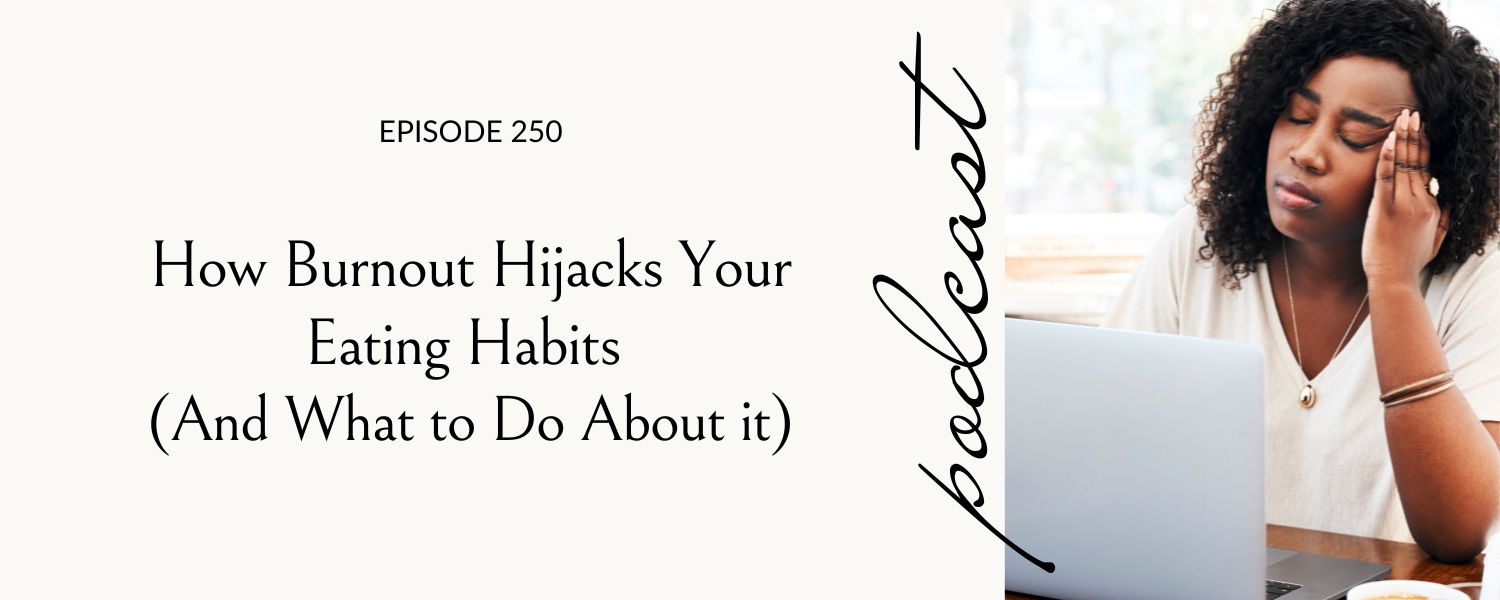
How Burnout Hijacks Your Eating Habits (And What to Do About it)
In this episode, Kate Johnston explains the real cause behind boredom eating and why common fixes like scrolling your phone or swapping in “healthier” snacks don’t actually solve it.
She breaks down why boredom eating is especially common among busy, high-achieving women in healthcare and similar demanding careers, and how the pattern can be fully unlearned.
Kate also walks through how to effectively break a boredom eating habit, the same approach she uses with clients.
🎧 Listen with the player below. Or, keep scrolling for the readable version.
Listen Now:
Take the next step to eating habits that finally support the life and body you crave. Start with a Free Consult.
Follow the Show and listen to more episodes to start forming healthier eating habits.
Related Episodes:
- 🎙️The Biggest Misconception About Stress Eating Habits That Keeps You Stuck
- 🎙️5 Ways to Avoid Stress Eating
- 🎙️Why Burnout Makes Food Feel Out of Your Control
Readable Version:
Why Does Burnout Make You Overeat?
Burnout dysregulates your nervous system, and your body reaches for food because food has always meant safety. This isn’t a willpower issue, it’s a physiology issue, and once you understand the mechanism, you can address it directly.
If you’ve ever wondered why does burnout make you overeat, you’re not imagining it and you’re definitely not alone. I’m Kate Johnston, a former Physician Assistant with 15 years of clinical experience, now working as an Eating Habits and Weight Loss Coach for women in healthcare and other demanding careers.
I see this pattern constantly with my clients, and there’s a real physiological reason behind it. So let’s walk through exactly what’s happening in your body, and what you can actually do about it.
I see this pattern constantly with my clients, and there’s a real physiological reason behind it. So let’s walk through exactly what’s happening in your body, and what you can actually do about it.
What is the connection between burnout and overeating?
Burnout means your nervous system’s stress response is chronically “on”, meaning it’s dysregulated, and that dysregulation is what drives you toward food.
Your body starts to feel unsafe, even when nothing dangerous is actually happening.
For some of you, burnout shows up as feeling wired and on edge, almost jittery. For others, it shows up as running on empty, completely exhausted.
Either way, your nervous system isn’t regulating itself the way it’s supposed to. And a stressed body will look for the fastest way back to feeling safe.
Why does food feel like relief during burnout?
Food has always signaled safety to humans, because we need it to survive. So when your nervous system is dysregulated, reaching for food is one of the fastest, most reliable ways your body knows how to calm itself.
This is why burnout and stress eating go together so often. It’s not about a lack of discipline… it’s your body doing exactly what it evolved to do.
There’s a second layer to this too, and it’s more about mindset than physiology. Most of my clients have incredibly structured days, whether that’s patients, meetings, a schedule someone else built for them, kids who need picked up, or a home life with its own set of demands.
So food can start to feel like the one part of the day with no rules. No structure. Nothing anyone else controls.
That’s why walking into the break room and seeing donuts can trigger this instant wave of relief before you’ve even taken a bite. Or why you go straight for the pantry the second you walk in the door, before your kids can ask you for one more thing.
What are the signs burnout is affecting your eating habits?
- Feeling like a prisoner to food, even though it feels like freedom in the moment
- Eating until you feel overly full, almost like you need that fullness to feel calm
- Reaching for food the moment you get a break, even when you’re not physically hungry
- Feeling like food is the one part of your day with no rules or restrictions
- Noticing weight gain that seems to track with periods of high stress
A real client example
One of my clients, we’ll call her Sarah, who came to me already in burnout for months. She runs a busy team at a startup, and she’s also trying to be the best mom and the best wife she can be.
So as you can imagine, she has lots of responsibilities and places high standards on herself.
She told me food had become the one part of her day with no rules… and that it felt like real freedom in the moment. But she also knew it was creating real problems for her.
She was gaining weight, losing energy, and not liking how she felt in her body. Food felt like freedom, but she also felt like a prisoner to it.
So we got to work regulating her nervous system by helping her brain and body feel safe again, and shifting her thoughts about her responsibilities so she felt more freedom around them.
She naturally started turning to food much less often, unless she was truly hungry for it.
How your thoughts affect your eating while in burnout
Here’s the thing, eating during burnout isn’t just a habit, it’s a loop. A thought leads to a feeling in your body, and that feeling drives the action.
So with burnout, the thought might be something like “this is my only break” or “I deserve this moment.” That thought creates a feeling of relief or permission in your body.
And that feeling is what drives you to the food, often before you’ve even consciously decided to eat. This is why trying to white knuckle the action itself rarely works for long.
Rather than trying to control the eating directly, we have to work upstream of it. That means addressing the nervous system state and the thoughts driving the feeling, rather than fighting the action in the moment.
How do you stop burnout from driving your eating habits?
You don’t start by changing anything about food. You start by helping your nervous system feel safer, little by little, every day.
Here’s why that matters. Right now, food is one of the main things signaling safety to your body, so if you try to remove it first, your nervous system pushes back even harder.
Instead, you add something in. Something small, something that fits into a full day, and something that tells your body it’s safe without needing food to do it.
Use forward movement. A walk, a light bike ride, or an easy stroll around your yard can help your body feel safe, as long as it stays relaxing rather than intense.
Connect with your body. Put your hand on your chest, your stomach, or your thighs, and breathe normally for at least 30 seconds. This helps signal safety directly to your nervous system.
Connect with your environment. Put your feet flat on the floor and your hands on the couch or chair, and notice how they feel against your body. This grounds your nervous system in the present moment.
The most common question my audience asks about this
The question I hear most is some version of “does this mean I just have to live with this forever.” And the answer is no.
You don’t have to change your job or overhaul your entire life to get out of burnout. What you do need is a different way of helping your body feel safe, one that doesn’t rely on food to get you there.
The small action to start today is simple. When you’d normally turn to food for comfort, or when you know you’re not hungry, or before a meal you tend to overeat at, try one of the 3 tools above first.
If catching yourself in the moment feels too hard right now, that’s okay too. Just build one of these tools into your day at any point, rather than waiting for the perfect moment to use it.
Quick answers to what you’re probably wondering
Is stress eating during burnout a form of emotional eating?
Yes. Burnout related eating is a type of emotional eating, driven by your nervous system seeking safety rather than by physical hunger.
Can you fix burnout eating without changing your diet?
Yes. The most effective starting point is nervous system regulation, not food restriction, since removing food before your body feels safe usually backfires.
How long does it take to stop stress eating from burnout?
It varies, but consistency matters more than speed. Clients who build 1 simple nervous system tool into their day tend to notice they’re reaching for food less, without forcing it.
Ready to feel calm around food again?
You just learned why burnout drives your eating habits, and the small first step to shift it. But doing this consistently, on your own, in the middle of an already demanding life, is hard.
That consistency piece is exactly what I help my clients with in my 1:1 coaching program, Lighter, using a framework built on real behavioral science rather than willpower or restriction.
If you’re stuck in eating habits you’d love to break, I can guide you.
It starts with a free consult where we’ll:
- ✅ Uncover what’s behind your eating habits that you’re not aware of
- ✅ Get clear on your deeper goals
- ✅ Map the next steps to break the habits for good and achieve those goals
Pick a time for me to help you by clicking the button below.
Kate Johnston is an Eating Habits and Weight Loss Coach, host of the Eating Habits for Life podcast, and a former Physician Assistant with 15 years of clinical experience. She specializes in helping women in healthcare break overeating and emotional eating habits for good through mindset and strategy coaching in her 1:1 program, Lighter.

KATE JOHNSTON
Eating Habits & Weight Loss Coach
I help high-achieving women change their eating habits at the root to support the life & body they love.
Book a free consult for your roadmap to a healthy relationship with food and weight loss you can keep.