Stop The Snacking Spiral
3 steps to start today to feel in control quickly. Video class + bonus tool to stay on track.
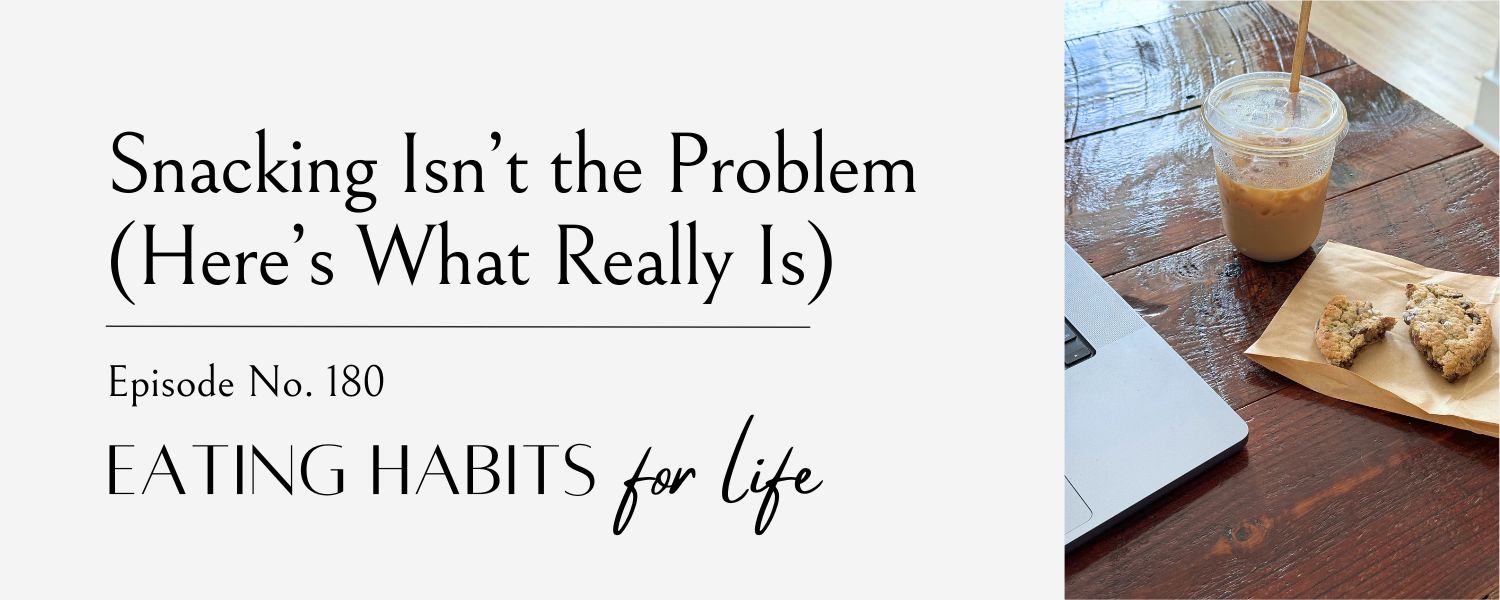
Snacking Isn’t the Problem (Here’s What Really Is)
Find yourself wandering into the break room with a sugar craving? Or grabbing a salty snack to watch TV with?
And then feeling frustrated because you thought, “If I just stopped snacking, I’d lose weight.”
I get it. But it’s not you. It’s not the snacks either. It’s what’s behind your snacking habits that matters.
In this episode, I’m helping you spot what’s behind your snacking habits, whether it’s mindless snacking, emotional eating, or something else.
I also give you a key mindset shift, plus the solution to breaking this eating habit. Plus, the benefits of breaking your snacking habit you didn’t even know about.
🎧 Listen with the player below. Or, keep scrolling for the readable version.
Listen Now:
(If player is taking a while to load, just refresh the page.)
You’re ready to break free from unhealthy eating habits, lose weight and keep it off.
Your next step is to book a free consult with me.
Click the button to book now and start feeling in control with food and confident in your body.
Listen to This Next:
- 🎙️ Habitual Eating: Why You Snack Without Thinking & How to Stop
- 🎙️ The Secret to Enjoying Sugar and Snacks Without Guilt
Enjoying the Show?
Help others discover the podcast by leaving a quick rating or review! It makes a huge difference.
- Rate/review on Apple (iTunes) HERE
- Rate on Spotify HERE
Know someone who’d benefit?
📩 Send them this episode link!
📖Readable Version:
Snacking Isn’t the Problem (Here’s What Really Is)
Hey there and welcome to the Eating Habits for Life podcast.
Do you ever find yourself wandering around the break room at work in the afternoon, secretly hoping someone brought in something sweet?
Or automatically heading to the kitchen in the evening—grabbing a snack before you even sit down on the couch?
And you could’ve done everything “right” the rest of the day, but that one snack made you feel like a failure.
If you’ve ever had any of this happen, you’re not alone. Snacking is one of the biggest eating habits that career women come to me with—and it often feels so out of their control.
That could be mindless snacking, frequent snacking, boredom snacking, nighttime snacking… really, any kind of snacking.
And if you’ve struggled with weight that won’t budge—or even weight that keeps creeping up—snacking might be one of the sneakiest culprits.
I know you’re even thinking, “If I could just stop snacking, I know I’d lose weight.”
👉 But here’s the truth: snacking itself isn’t “bad.” The real issue is why and how we snack. And once you understand that, everything changes.
In this episode we’re diving into:
- Why we snack (so you can uncover what’s really behind it)
- The hidden costs of “auto-pilot” snacking
- A mindset shift that changes everything
- The real solution
- And the surprising benefits you didn’t even realize were waiting for you
That last one? It’s the piece that tends to open my clients’ eyes the most, so stick with me until the end.
Why You Snack (The Real Reasons)
Your snacking habits can mean one of several things. Here are the most common ….
#1 Physical Hunger
I literally just finished eating cashews and almonds, because I got off a coaching session with a client and was moderately hungry. I could feel that stomach emptiness, and it was gradually coming on halfway through the session.
So, snacking was originally meant to satisfy physical hunger in between larger meals, such as between breakfast and lunch or lunch and dinner, or even sometimes dinner and then breakfast the following morning.
This is a good reason to snack—your body is simply asking for energy.
The real challenge is learning how to tell the difference between hunger and all the other reasons we reach for food. That clarity is one of the first things I work on with my clients.
When you can recognize true hunger signals—like stomach growling, lightheadedness, or even a mild headache—you can trust your body again, instead of second-guessing yourself.
#2 Other Physical Needs
The second is other physical needs. Sometimes we end up snacking because we’re Lacking in rest or sleep, and sometimes even because we’re dehydrated. I will sometimes wake up with hunger signals in the middle of the night, but I’ve discovered that if I drink a bottle of water, it often goes away.
Or if I’ve gotten really poor sleep the night before, the hunger hormone grehlin is a little bit more active and I typically feel hungry more frequently throughout the day than I normally would.
Have you ever noticed you’re ravenous after a bad night’s sleep? My clients often breathe a sigh of relief when they realize, “Oh, nothing’s wrong with me. My body just needed rest or hydration.
#3 Emotional Needs
This one’s huge. A lot of snacking happens because of emotions: stress, boredom, procrastination, even reward. And because snacks work in the short term, our brain wires that habit in.
It’s like a friend you always turn to when you’re upset—they comfort you, so next time you feel crummy, you go back to them. Snacks can become that “friend.”
Here’s the good news: once you learn how to manage those emotions without food, the urge to snack constantly fades. This is one of the most powerful shifts my clients experience—they’re shocked by how freeing it feels to no longer need food to handle emotions.
I found how freeing it personally feels to no longer find myself drawn to food when I wanted to relax or de-stress. I could then choose more effective ways to manage my emotions, ways I feel really great about.
#4 Environmental, Social, and Situational Triggers
Sometimes it’s not hunger or emotions—it’s just what’s in front of you. The smell of pastries, coworkers offering food, that nightly “TV and snacks” routine.
When these triggers repeat, they hardwire into habits. That’s why you might find yourself standing in the kitchen almost on autopilot. It’s not that you’re weak—it’s that your brain is efficient.
And here’s where coaching makes a difference: once you know your triggers, you can retrain your brain to respond differently. You don’t have to live at the mercy of the office break room or your 8pm routine.
The Hidden Costs of a Snacking Habit
So I think one of the obvious ones is that if you’re eating more food than your body actually needs for the day or for the week, then you’re likely going to either gain weight or have difficulty managing your weight or losing weight.
When we’re eating more food than we need for energy, your body ends up storing that on your body to be used later for energy. It’s kind of like if you had a whole bunch of clothes in your closet and you don’t necessarily need all of them, but you never know when you’re going to need that formal dress or that interview suit, so they’d end up just staying in your closet, taking up space.
That’s pretty much what happens when you end up eating more than you need. Your body’s like yeah, we don’t need this now, but we might need it later.
Another common hidden cost of snacking habit when you’re snacking due to emotional reasons, or environmental, social, or situational triggers, is a loss of trust with yourself.
Which really affects how you feel about yourself.
For example, you might have thought “why did I eat that I wasn’t even hungry.” Or, “I’m trying to lose weight, why do I keep sabotaging myself?”
Which then makes you feel guilty, ashamed, disappointed in yourself, frustrated in yourself. And then this can really spiral and sometimes cause you to just plain give up, or feel like since you blew it, you might as well just keep going that day and then start over the next day, or start over on Monday. Then that really sets you back, causing even more frustration or guilt.
This is one of the biggest reasons women come to me. They’re not just tired of the weight gain. They’re tired of the mental load of food—thinking about it, regretting it, starting over every Monday.
Which is why, when I work with my clients, you get really good at stopping this guilt cycle, shame cycle, or frustration cycle from occurring. Even if you eat something when you weren’t hungry, you can still stop the cycle from happening, just by what your next thoughts are.
Because your thoughts about it, creates a different emotion besides guilt or frustration. And then your actions are different. So essentially, it’s course correcting.
Another hidden cost of a snacking habit that’s not due to physical hunger is that it distracts from your real needs.
So for example, if you were snacking for an emotional reason like stress, then you’re not able to actually get this type of stress relief that’s actually much more effective. Or maybe if you’re snacking due to a lack of sleep, then you’re not getting the real rest that you need.
The Mindset Shift to Help Break a Snacking Habit
The mindset shift is looking at your snacking habit as neutral. Neither good, nor bad. Just data.
That’s how you start problem-solving instead of shaming yourself. And once you shift to curiosity instead of judgment, everything opens up.
(And by problem solve, I mean figure out why you’re snacking and what it is that you actually need.)
If you’re looking at your snacking habit in a very negative way, it’s going to be harder to get curious and see what it might be behind the snacking that’s causing it.
So if you find yourself snacking, maybe it is that you’re truly hungry. Maybe it’s that you were feeling really stressed. Maybe it’s that you were procrastinating making that colonoscopy appointment you didn’t want to make, but promised yourself you would today. Maybe it’s procrastinating getting started on a work project.
Or maybe it’s that you saw someone else eating, and as humans, we just like to mimic what other humans are doing. Or maybe someone offered you something and you felt bad saying no, because you’re a kind person.
But we won’t know how to solve for these things unless we know what’s behind the snacking habit.
And we won’t know that unless we get curious, rather than judgmental about ourselves. Because when we’re judgmental, we tend to be really hard and tell ourselves some not very nice things. I know I certainly do sometimes.
The Solution to Your Snacking Habit
The solution isn’t cutting out snacks altogether… it’s intentional snacking.
When you’re intentional, you’re no longer on autopilot. You’re choosing, and you’re also meeting your real need—whether that’s hunger, stress relief, or rest.
This is exactly the kind of transformation I help women with inside my 1:1 coaching program, Eat with Intention. Once you identify the true “why” behind your snacking, we can build strategies that stick for life.
The Benefits of Intentional Snacking
When you snack intentionally and break the habitual snacking habit, and also when you intentionally manage what’s behind the snacking habit, there are lots of different benefits.
One of the biggies is that you are eating more in alignment with what your body actually needs, so you’re going to be less likely to be overeating, which will lead to either weight loss or halting weight gain.
The snacks that you are eating for physical hunger, you’ll enjoy those more. Especially since it won’t be mindless and you could actually pay attention to what you’re eating, which results in much more satisfaction.
You don’t have those negative emotions anymore like guilt, shame, frustration, disappointment in yourself.
You feel so much more calm, confident, and in control around food, especially snacky foods.
You can actually address the emotional needs and even the physical needs like rest or dehydration, which is then going to make you of course feel so much better.
You’ll likely feel more energized. One of my clients just recently told me that one of her favorite things that came out of working together, is that she feels more energized, which allows her to do more of the things she absolutely loves doing.
And imagine if you’re feeling calm, confident, in control, energized, losing some weight, not feeling stuck in that guilt, starting over on Monday cycle.
Imagine how you’d feel waking up every day, and walking into work, and coming home at night.
Imagine the interactions with your family and your friends and even just how you talk to yourself, meaning the thoughts that you’re thinking in your head all day long about yourself.
Much more positive ones, which is then going to make you feel more positive. And if you feel more positive, you’re going to show up differently in the world.
So it’s not just eating habits my friend. It’s not just snacking habits. It affects all different aspects of your life in a really big way.
The Fastest Way to Break Your Snacking Habits
If you’re listening right now and thinking, “That’s me. I’m tired of feeling like snacks or cravings run the show,” I want you to know, you don’t have to figure this out on your own.
This is exactly the kind of work I do with my clients inside my 1:1 coaching program, Eat with Intention.
Together, we get to the root of your eating habits and build strategies that actually fit your life—so you can feel calm, confident, and in control around food again.
✨ The best way to start is with a free consult. You’ll walk away with clarity on what’s really driving your eating habits, and a plan for how to move forward.
Just head to the link in the show notes (also known as the episode description) to book your consult today.
Thanks so much for listening, take care and talk to you soon.
Ready to feel lighter?
A lighter body. Lighter relationship with food. Lighter emotional load. Lighter burden around eating.
A lighter way of living — for life.

KATE JOHNSTON
Eating Habits & Weight Loss Coach
I help high-achieving women change their eating habits at the root to support the life & body they love.
Book a free consult for your roadmap to a healthy relationship with food and weight loss you can keep.