
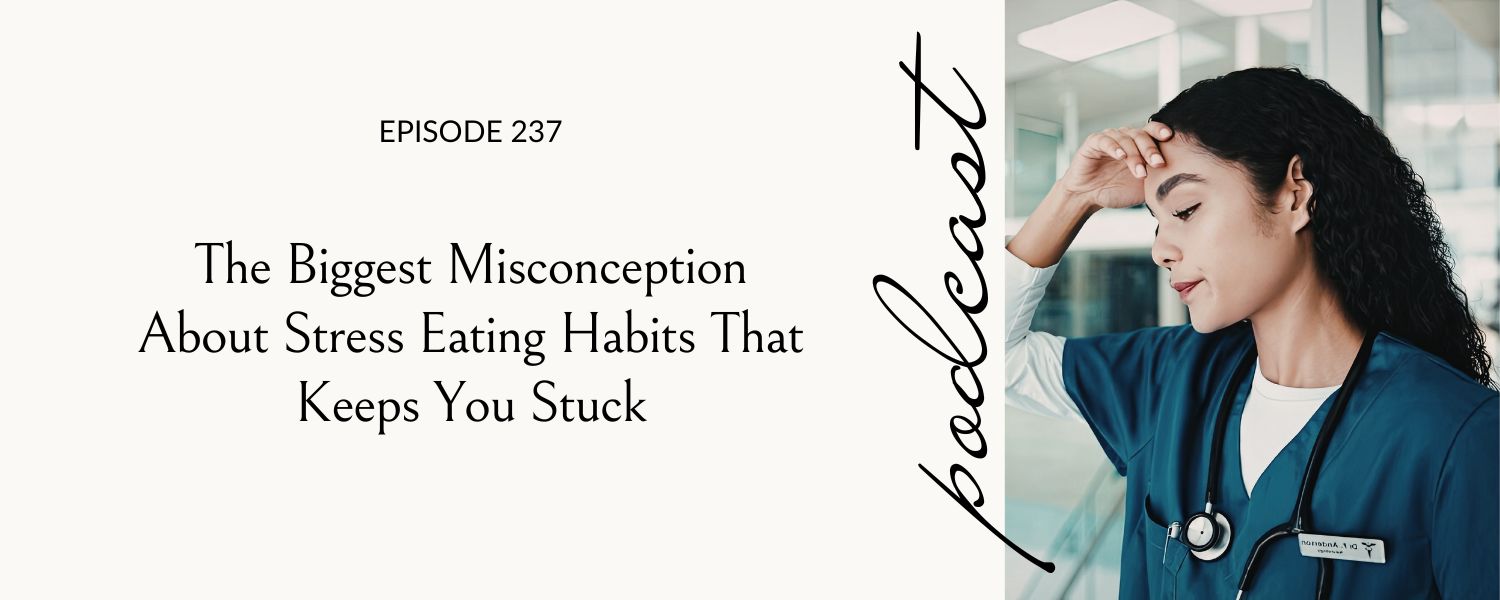
The Biggest Misconception About Stress Eating Habits That Keeps You Stuck
This episode of Eating Habits for Life podcast breaks down the biggest misconception about stress eating habits: that you have to eliminate stress before you can stop stress eating.
As a former Physician Assistant turned Eating Habits and Weight Loss Coach, Kate Johnston explains how thoughts, not circumstances, create the stress that drives emotional eating, and what actually has to change to break the habit for good.
If you’re a woman in healthcare struggling with stress eating, emotional eating, or overeating at work or at home, this episode is for you.
🎧 Listen with the player below. Or, keep scrolling for the readable version.
Listen Now:
Finally break free from overeating and emotional eating habits: Start with a Free Consult.
Follow the Show and listen to more episodes to start forming healthier eating habits.
Related Episodes:
- 🎙️5 Ways to Avoid Stress Eating While Working in Healthcare
- 🎙️When Work Stress Makes You Want to Stress Eat
Readable Version:
The Biggest Misconception About Stress Eating Habits That Keeps You Stuck
Stress eating habits are not caused by stress itself — they’re caused by your thoughts about stressful circumstances, and that distinction is what makes it possible to break the habit even if your life doesn’t get any less stressful.
If you’ve ever caught yourself thinking, “I’ll probably always stress eat because I’ll always have stress,” you’re not alone, and honestly, that thought makes complete logical sense.
But it’s also the exact belief that keeps so many women in healthcare stuck in the cycle. And I want to offer you a reframe today that changes everything.
I’m Kate Johnston, a former Physician Assistant with fifteen years of clinical experience, and now an eating habits and weight loss coach for women in healthcare. I spent years stress eating my way through long OR days, triple-booked clinic days, and everything life was throwing at me outside of work too.
I tried all the surface-level fixes. Distracting myself. Going for a run. Watching a funny “I Love Lucy” episode. And while those things felt good in the moment, they never actually touched the stress eating. Not until I understood what was really driving it.
What Is Stress Eating, Really?
Stress eating is when you turn to food, not because you’re physically hungry, but because you’re trying to get relief from stress or another uncomfortable emotion. It’s a habit your brain developed because food is quick, available, and reliably provides a temporary feeling of comfort or reward.
Here’s what’s important to understand about why that happens: your brain’s primary job is to keep you safe and avoid discomfort. When you feel stressed, your brain goes looking for the fastest way to feel better. If food has been that reliable source of relief in the past, your brain is going to keep recommending it.
That’s not a “problem with you” thing. That’s just how habits and the brain work.
Does Stress Cause Stress Eating?
This is where the biggest misconception lives, so let’s go right at it.
Stress does not come directly from your job, your patients, your kids, your finances, or anything else happening around you. Stress comes from your thoughts about those things, your perception. Your thoughts create feelings in your body, including stress, overwhelm, and anxiety, and it’s those feelings that lead to stress eating.
Here’s an example. Imagine a nurse who arrives at her shift and gets assigned three high-needs patients on an already demanding day. The circumstance, the patient assignment, is neutral on its own. What creates the stress is the thought she has about it.
If she thinks, “There’s no way I can keep up. I’m going to fall behind and make mistakes and everyone will think I’m incompetent,” that thought creates feelings of overwhelm and anxiety.
Those feelings are uncomfortable. So when she finally gets a break, she finds herself in the break room reaching for whatever’s within arm’s reach — not because the assignment caused stress eating, but because her thoughts about the assignment created stress, and she’s using food to soothe it.
Now imagine the exact same assignment with a different thought: “This shift is heavy, but I’ve handled hard days before and I’ll take it one patient at a time.”
That thought creates something completely different. Maybe determination. Maybe calm acceptance. She might still want a snack on her break, but she’s no longer driven to eat as a way to escape an overwhelming feeling.
The circumstance didn’t change. The patient load was identical. What changed was the thought, and that changed the emotion, and that changed the urge to stress eat.
Why Willpower and Distraction Don’t Fix Stress Eating
Most approaches to stopping stress eating are aimed at the behavior itself. Eat less. Use portion control. Distract yourself with something else. And while distraction can interrupt an urge in the moment, it never addresses what’s underneath it.
Here’s why that matters:
- Willpower relies on mental energy, and you are already depleted by the end of a demanding shift
- Distraction temporarily takes your mind off the urge but doesn’t change the feeling that created it
- Portion control assumes the issue is hunger, when it’s actually an emotional response
- None of these approaches change the thought patterns that are creating the stress in the first place
When you only try to change the behavior without addressing the thought or emotion driving it, the habit keeps coming back. Every time. Because the root cause is still there.
The Role of the Nervous System in Stress Eating
It’s also worth knowing that stress isn’t always purely mental. Your nervous system is constantly picking up cues from your environment and deciding whether you’re safe or under threat.
Being around someone who is angry or emotionally intense, working in a loud and chaotic environment, constantly multitasking or rushing… all of these can put your nervous system into a heightened state, and that physiological stress can contribute to the urge to eat even when you’re not consciously aware of feeling stressed.
Your thoughts can either amplify that physiological response or help to calm it. And when you combine working with your thoughts and learning nervous system regulation tools, the combined effect on stress eating is significant.
This is something I work on directly with my clients inside Lighter, my one-on-one coaching program for women in healthcare. One of my clients was under a heavy load of stress from both work and her personal life.
After building a consistent habit around a couple of nervous system regulation tools I taught her, she found she was no longer turning to food to cope. But the key word there is consistent. These tools work, and they work much better when they’re practiced regularly rather than only reached for in a moment of crisis.
How to Actually Stop Stress Eating: Addressing the Root Cause
So what does it actually look like to break a stress eating habit at the root? Here’s the process:
Practice consistently. A single use of any of these tools helps a little. Consistent practice is what rewires the habit and makes food feel genuinely unnecessary as a coping mechanism.
Identify the thought. When you notice the urge to stress eat, pause and ask yourself what you were just thinking. Not what happened, but what you thought about what happened. That thought is almost always where the stress originated.
Name the emotion. What feeling did that thought create? Overwhelm? Anxiety? Resentment? Naming it gives you a little bit of distance from it and makes it feel less automatic.
Address the physical sensation. Stress creates real physical sensations in the body — tightness in the chest, shallow breathing, tension in the shoulders. You can work with those directly through breathing, movement, or nervous system regulation practices rather than using food to try to escape them.
Shift the thought intentionally. This doesn’t mean forcing yourself to think positively. It means finding a thought that’s both true and slightly more helpful than the one creating the spiral. “This is hard, and I’ve handled hard things before” is enough to shift the emotional experience.
Can You Stop Stress Eating Without Reducing Your Stress?
Yes. And this is the part that tends to surprise people the most.
You don’t have to wait for a less stressful job, a quieter home, or a different season of life. The stress eating habit isn’t locked to the stress itself. It’s locked to the thoughts that create the stress and the pattern of using food to manage the emotion that follows.
When you start addressing those thoughts and learning to regulate your nervous system consistently, your brain learns that stress isn’t as overwhelming or threatening as it once felt. And when stress feels more manageable, there’s simply less drive to reach for food as a way to escape it.
You’ll still feel stressed sometimes. Stress is a normal human experience and it’s not going anywhere entirely. But it stops feeling so all-consuming, and it stops automatically sending you to the kitchen or the break room snack table.
What Changes When You Break the Stress Eating Habit
One of my clients, Janelle, started noticing which thoughts were creating her stress, anxiety, and overwhelm during our work together. That awareness alone made those emotions feel less intense, because she could see where they were coming from and realized she had more influence over them than she thought.
By the end of our work together, she had lost the final seven or eight pounds she wanted to lose and had stopped overeating and emotional eating.
But beyond the weight loss, she experienced less anxiety overall, less stress, and felt more confident in her ability to manage difficult emotions. She built a habit she can use for the rest of her life.
That’s what breaking a stress eating habit at the root actually looks like. It’s not just about food. It’s about feeling more in control of your inner world, which then makes the food stuff so much easier.
Ready to Finally Feel Free From Stress Eating, Food Noise, and the Frustration Around Your Weight?
If you’re tired of the cycle… the stress, the eating, the guilt, the trying again… and you’re ready to finally address what’s actually driving it, I’d love to talk with you.
Inside Lighter, my one-on-one coaching program for women in healthcare, we get to the root of your stress eating, emotional eating, and overeating habits so the change is real and lasting. You stop white-knuckling it. You stop replaying what you ate. You stop feeling like food has this grip on you that you can’t shake.
You get to feel calm around food. Confident in your body. Free from the noise in your head that tells you you’ve failed again.
Book a free consult with the button below and let’s talk about what’s keeping you stuck and what’s actually possible for you.
You’ve spent enough time trying to manage this on your own. Let’s actually fix it.
Kate Johnston is an Eating Habits and Weight Loss Coach, host of the Eating Habits for Life podcast, and a former Physician Assistant with 15 years of clinical experience. She specializes in helping women in healthcare break overeating and emotional eating habits for good through mindset and strategy coaching in her 1:1 program, Lighter.

KATE JOHNSTON
Eating Habits & Weight Loss Coach
I help high-achieving women change their eating habits at the root to support the life & body they love.
Book a free consult for your roadmap to a healthy relationship with food and weight loss you can keep.