
Hi, I’m Kate — I help women in healthcare lose weight sustainably, without willpower.
I’ll show you how in a free consult, which is a compassionate and safe space.
Hi, I’m Kate — I help women in healthcare lose weight sustainably, without willpower.
I’ll show you how in a free consult, which is a compassionate and safe space.
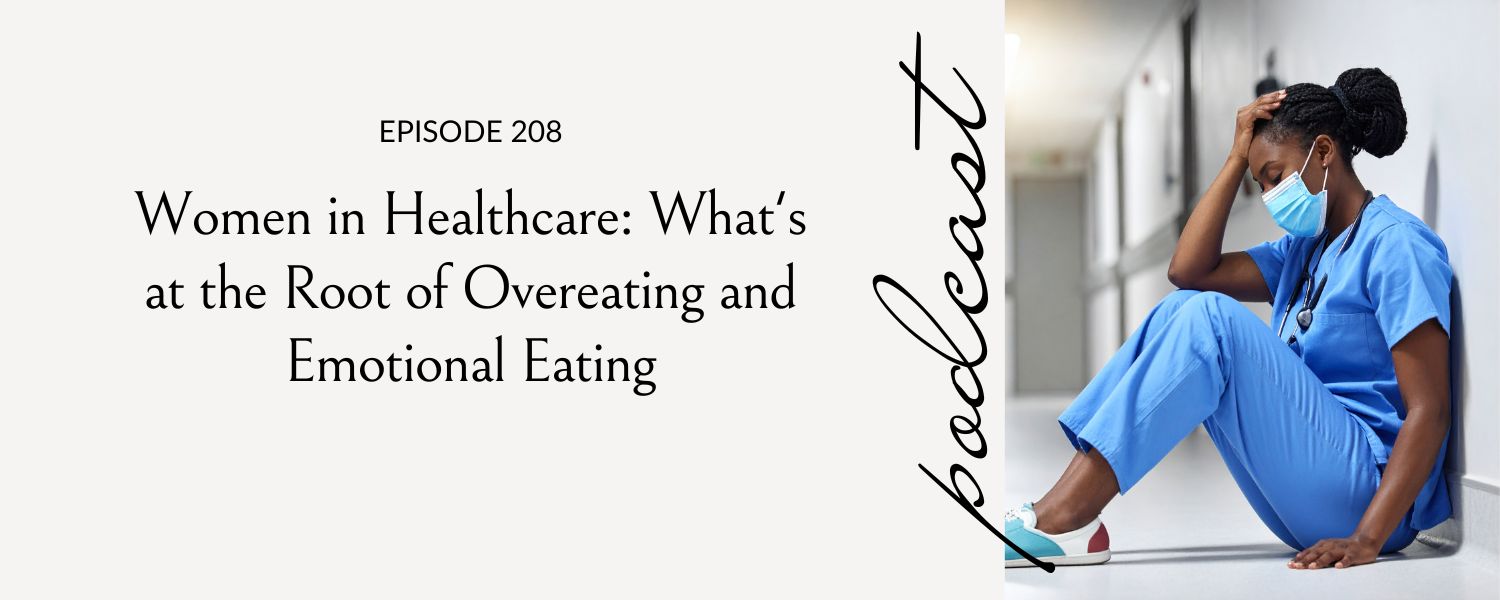
Women in Healthcare: What’s at the Root of Overeating and Emotional Eating
If you’re a woman in healthcare who holds it together all day but feels out of control around food, this episode is for you.
In this conversation, I break down why overeating, emotional eating, cravings, and mindless snacking are a response to exhaustion, nervous system overload, beliefs and habit loops.
You’ll learn what’s really happening in your brain and body, why food has become a source of relief, and why more self-control only makes the cycle worse.
Most importantly, you’ll walk away with a mindset shift that replaces shame and frustration with something that actually supports change.
🎧 Listen with the player below. 👇🏼Or, keep scrolling for the readable version.
P.S. 🤍If this episode feels like it was describing you…
I work 1:1 with women in healthcare through a coaching program designed to help you feel calm, confident, and in control around food — without deprivation or more willpower.
The first step is a free consult to explore what’s actually driving your eating habits and see if working together is a fit.
Listen Now:
(If player is taking a while to load, just refresh the page.)
Yes, You Can Lose Weight Without Willpower.
Imagine eating what feels good to your body, and trusting yourself around your favorite foods. Losing weight without forcing anything. Wanting to check yourself out in the mirror, and feeling confident.
You can have this, even if it feels far away right now. And even in a demanding career like healthcare.
Take the first step now with a free consult.
This is a safe and compassionate space for me to learn about you, and share my process that creates sustainable weight loss for you.
Click the button below to pick and date and time to meet.
Listen to This Next:
- 🎙️Why Burnout Makes Food Feel Out of Your Control
- 🎙️Why Perfectionism Triggers the Binge–Restrict Cycle (Even When You’re Disciplined All Day)
Enjoying the Show?
Help others discover the podcast by leaving a quick rating or review! It makes a huge difference.
- Rate/review on Apple (iTunes) HERE
- Rate on Spotify HERE
Know someone who’d benefit?
📩 Send them this episode link!
📖Episode Transcript (Easy-to-Read Version):
Women in Healthcare: What’s at the Root of Overeating and Emotional Eating
If you work in healthcare, chances are you’re very good at holding it together.
You’re responsible. Trusted. Capable. People rely on you, sometimes with their lives. You manage constant demands, shifting priorities, emotional situations, and high expectations, often without much room to pause or decompress.
And yet… food might feel like the one area where everything unravels.
You may find yourself overeating at night, snacking mindlessly after work, craving sugar or comfort foods, or feeling out of control around food in a way that doesn’t make sense, especially given how disciplined and competent you are everywhere else.
If that sounds familiar, I want you to hear this clearly:
You are not failing with food. You’re exhausted.
This post will walk you through what’s actually driving overeating and emotional eating for women in healthcare, and why the solution has nothing to do with more willpower, discipline, or restriction.
Why Women in Healthcare Struggle with Overeating and Emotional Eating
Healthcare work comes with a unique and heavy load.
It’s not just the physical tasks of your job… it’s the emotional weight. Holding space for patients. Making high-stakes decisions. Being the steady presence in stressful or traumatic situations. Showing up calm, capable, and composed no matter what’s happening internally.
Many women in healthcare also grew up being “the strong one”, the caretaker, the responsible one, the person others leaned on. So it makes sense that you gravitated toward a career centered on caring for others.
But along with that role comes an unspoken expectation:
- Don’t fall apart
- Don’t need too much
- Don’t make mistakes
- Keep it together at all costs
You do this well. You have to.
So when food feels chaotic, when you overeat, snack impulsively, or feel out of control… it can feel deeply confusing and shame-inducing.
Why food? Why this area of life?
The Problem Isn’t Lack of Willpower or Self-Control
Many women assume their eating struggles mean something is wrong with them.
Common thoughts I hear from women in healthcare include:
- “I have no self-control around food.”
- “I just can’t stay consistent.”
- “I’m addicted to sugar.”
- “I should know better.”
These beliefs feel true — but they’re not the root of the problem.
In fact, believing these thoughts often keeps the cycle going.
Your brain is wired to align your actions with what you believe about yourself. When you believe you lack self-control, your behaviors will subconsciously reinforce that belief. You’ll feel out of control around food, then use that moment as proof that the belief must be true.
But this is only one small piece of the picture.
Physical Exhaustion Drives Overeating
Healthcare is physically demanding… long shifts, skipped meals, inconsistent schedules, and limited breaks are common (as you well know!)
When your body is physically exhausted, it seeks energy.
Food becomes the fastest, most accessible source of that energy.
This is why many women notice overeating later in the day, especially after work. You may come home planning to cook dinner, only to find yourself snacking on cheese, crackers, candy, or whatever is easy and available.
By the time dinner is ready, you’re not hungry, but you eat anyway, often past comfort.
This isn’t a failure of discipline.
It’s your body responding appropriately to depletion.
Emotional Exhaustion and a Dysregulated Nervous System
In addition to physical exhaustion, many women in healthcare are emotionally exhausted.
Throughout the day, you’re required to suppress your own emotions so you can function professionally. Stress, frustration, sadness, overwhelm… they don’t disappear just because you ignore them.
They stay stored in the nervous system.
Most of us were never taught how to process emotions or complete the stress cycle. When emotions aren’t fully processed, the nervous system remains activated. Over time, this leads to a dysregulated nervous system, often stuck in fight, flight, or freeze.
Burnout is a common sign of this.
And here’s where food enters the picture.
Why Food Feels So Comforting When You’re Not Hungry
A dysregulated nervous system feels unsafe, even when your life looks objectively stable. You can feel sort of calm on the outside, but your nervous system is still in flight, fight or freeze.
Food signals:
- Safety
- Relief
- Predictability
- Dopamine (pleasure)
- Temporary emotional regulation
For thousands of years, food has been tied to survival. Your brain still interprets it that way.
So even if you live in a safe home, have a stable job, and supportive relationships, unresolved stress and unprocessed emotions can make your body feel unsafe.
When safety feels lacking internally, food becomes a powerful regulator.
This is why you might:
- Eat when you’re not physically hungry
- Eat past fullness
- Binge or snack mindlessly
- Feel drawn to food automatically
Your body isn’t broken. It’s trying to protect you.
Restriction Makes the Cycle Worse
Another factor that contributes to overeating is under-eating or restriction.
Many women in healthcare don’t eat enough during the day because:
- They’re too busy
- They don’t feel they “deserve” a break
- They’re trying to lose weight
- They’re avoiding certain foods
When your body perceives scarcity, it responds by increasing urgency around food later.
Even if you know food is available, a primitive part of your brain senses deprivation and pushes you to eat more when the opportunity arises.
This survival response is not conscious, and it’s not something you can override with logic.
Why Overeating Feels Automatic: Habits and Neural Pathways
Your brain is designed to conserve energy.
When it notices you repeatedly responding to the same situation in the same way, it forms habits … neural pathways that make behaviors feel automatic.
For example:
- Stressful meeting → muffin from the cafeteria
- End of the day → snacks on the couch
The relief you feel reinforces the habit.
Eventually, the behavior happens before you even feel like you’ve decided.
This is why overeating often feels out of control, but it’s actually a learned, reversible pattern.
The Real Root Causes of Emotional Eating in Healthcare
To summarize, emotional eating and overeating are driven by:
- Unhelpful beliefs about yourself
- Physical exhaustion
- Emotional exhaustion
- A dysregulated nervous system
- Restriction or under-eating
- Habitual neural pathways
When you try to solve these problems with more control or restriction, you end up fighting your body and brain, which makes the cycle stronger.
The good news?
This is workable.
The Solution: Working With Your Brain and Body
Lasting change doesn’t come from more discipline.
It comes from giving your brain and body what they actually need so food no longer has to do that job.
This includes:
- Shifting unhelpful beliefs through evidence-based thought work
- Regulating the nervous system and learning how to process emotions
- Interrupting habit loops by addressing real triggers
- Making small, sustainable changes that don’t overwhelm your system
This is the work I do with women in healthcare through 1:1 coaching.
Not to “fix” you, but to help you feel calm, confident, and in control around food again.
You Don’t Have to Be Ready, You Just Have to Want Something Better
You don’t need perfect timing.
You don’t need more motivation.
You don’t need to try harder.
If food has become the one area of your life that feels frustrating and heavy, there is another way.
The first step is a free consult, a conversation to explore what’s actually driving your eating habits and whether coaching is a good fit.
A Final Mindset Shift
Instead of thinking:
“I have no self-control around food.”
Try this on:
“My eating patterns don’t mean anything about me. They’re a response to caring deeply for others, and now it’s time to care for myself.”
Notice how that feels.
And imagine the actions you’d take from that place.
Peace with food is possible… even in healthcare.
Book your free consult to start your journey today.
You CAN lose weight and keep it off.
By breaking habits like overeating and emotional eating, and thinking like the person who keeps it off naturally.
The first step is a free consult to discover how.

KATE JOHNSTON
Eating Habits & Weight Loss Coach
I help women in healthcare and perfectionists break their toughest eating habits like overeating and emotional eating, and lose weight sustainably.
Discover how by booking your free consult below.